

BioShock Infinite takes one of gaming’s most recognisable series out of the underwater corridors of Rapture and sends it into the clouds. Irrational Games replaces the dark, enclosed spaces of the original BioShock with Columbia, a floating city filled with bright skies, colourful streets and an unsettling vision of early 20th-century American exceptionalism.
The change of setting is enormous, but this still feels unmistakably like BioShock. Firearms share combat with supernatural abilities, exploration rewards curiosity, and the story gradually reveals that the apparent paradise surrounding the player is anything but.
I originally reviewed BioShock Infinite on PC shortly after its 2013 release and came away extremely impressed. The story, combat and visual design were the biggest strengths for me, although enemy AI and several glitches stopped the experience from being quite as polished as it first appeared.
More than a decade later, its individual systems are easier to judge against both its predecessors and the games that followed. Some elements have aged better than others, but Columbia remains one of the most memorable settings Irrational Games ever created.
Quick Links:
Columbia and the Story of Booker DeWitt
BioShock Infinite puts players in control of Booker DeWitt, a former Pinkerton agent sent to Columbia to retrieve a young woman named Elizabeth. His instructions appear straightforward: bring Elizabeth to New York and his debts will be cleared.
Getting her out of Columbia is another matter.
Elizabeth has been imprisoned in the city since childhood and is guarded by Songbird, a huge mechanical creature with an intense attachment to her. Her ability to open Tears in reality also makes her central to events that extend far beyond a simple rescue mission.
Columbia initially presents itself as an idyllic city in the clouds. Its architecture, music, celebrations and immaculate public spaces create an almost dreamlike introduction. That presentation soon begins to collapse as Booker encounters the racism, class division, religious extremism and political violence beneath the city’s carefully constructed image.
That contrast is one of BioShock Infinite’s greatest strengths. Rapture introduced its philosophy through the ruins of a society that had already destroyed itself. Columbia allows Booker to walk through a functioning society before its contradictions become impossible to ignore.
The story becomes increasingly complicated as Tears and alternate realities move to the foreground. Infinite asks the player to follow concepts involving different versions of events, recurring choices and the consequences of Booker’s past.
I considered the story one of the game’s strongest elements when I first played it, and that remains an important part of the original 9.5/10 judgement. Infinite is willing to make its narrative increasingly strange without abandoning the relationship at its centre.
Elizabeth Changes More Than the Story

Elizabeth is not simply someone Booker escorts from one objective to another.
She accompanies him through large parts of the campaign but does not need to be manually protected during combat. Instead, Elizabeth supports Booker by finding and throwing useful resources such as ammunition, health and Salts when he needs them.
Her most distinctive ability involves Tears.
Elizabeth can manipulate certain Tears during encounters, allowing useful objects to enter the battlefield. Depending on the available Tear, Booker can gain access to equipment such as weapons, automated turrets, cover or other tactical resources.
This gives Elizabeth a meaningful gameplay role without turning every battle into an escort mission.
Her contribution outside combat is equally important. Elizabeth reacts to Columbia, talks with Booker and becomes increasingly involved in the decisions driving the story. The relationship between the two characters develops alongside the player’s understanding of the city rather than being confined to cutscenes.
That made Elizabeth one of the characters I remembered most strongly from my original playthrough. Her presence gives long stretches of the campaign a character dynamic that would be missing if Booker travelled through Columbia alone.
Weapons, Vigors and Combat
BioShock Infinite is a first-person shooter, but conventional firearms are only one part of its combat system.
Booker can carry two weapons at a time, forcing the player to make more immediate choices about the firearms available during an encounter. Pistols, shotguns, machine guns and heavier weapons cover different ranges and combat situations, while upgrades allow money to be spent improving individual weapons.
The two-weapon restriction makes Infinite feel different from the broader arsenals associated with earlier BioShock games. It encourages swapping weapons found around Columbia, although I still prefer having greater freedom to build and retain a larger personal arsenal.
Vigors provide the other half of Booker’s offensive toolkit.
These abilities fill a similar role to Plasmids in the original BioShock but have their own identities and upgrades. Possession can turn machines and enemies against their allies, while Shock Jockey delivers an electrical attack. Murder of Crows sends a swarm of birds at enemies, and Devil’s Kiss provides a fire-based attack.
Using Vigors consumes Salts, making Salts a combat resource that has to be replenished.
Combining firearms with Vigors creates the best fights. An ability can disrupt or immobilise an enemy before Booker follows with gunfire, while environmental opportunities allow certain powers to become more useful than they initially appear.
Gear adds another layer of character customisation. Individual Gear items provide passive effects when equipped, allowing bonuses to be applied across several equipment slots.
The combat impressed me enormously in 2013 because encounters rarely felt limited to standing behind cover and exchanging gunfire. I found myself constantly switching between weapons and abilities depending on the enemies in front of me.
Enemy behaviour was less convincing. I noticed opponents occasionally behaving strangely or failing to respond intelligently to Booker’s position. It did not ruin the combat, but it was one of the areas where the presentation and mechanical ambition were ahead of the AI supporting them.
Sky-Lines and Tears Change the Battlefield
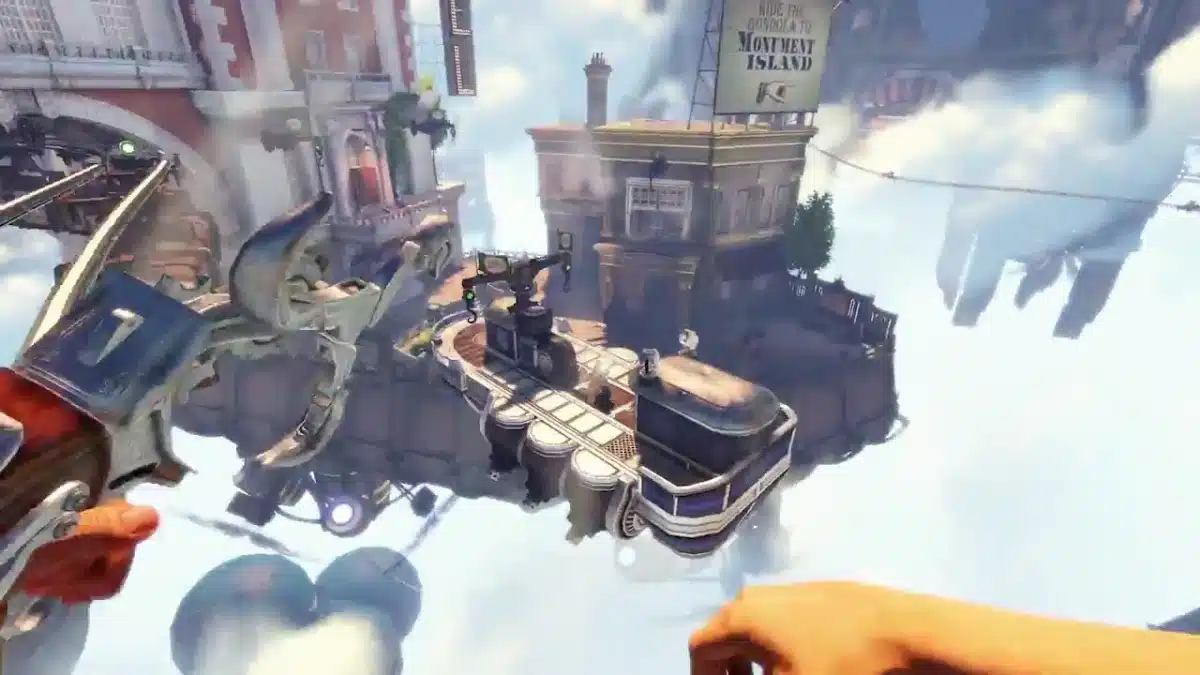
Columbia’s Sky-Lines are more than a method of travelling between areas.
Booker can attach to these rail systems with the Sky-Hook and rapidly move around certain environments. During combat, Sky-Lines provide an opportunity to escape pressure, reach another position or attack enemies from a different angle.
The result is a more mobile form of BioShock combat.
Some of Infinite’s strongest encounters take place in spaces where weapons, Vigors, Tears and Sky-Lines can all be used together. Booker can leave the ground, reposition himself, select another target and return to the fight from a completely different direction.
Elizabeth’s Tears complement that mobility because they allow the battlefield itself to change. Opening a useful Tear can provide an advantage that was not physically present moments earlier.
Neither system turns Infinite into a completely freeform sandbox. Combat still takes place within designed encounter spaces and available Tears are predetermined. However, they provide enough tactical choice to stop the larger battles from becoming straightforward shooting galleries.
The Sky-Hook also works as a melee weapon. It gives Columbia’s transport system a direct connection to combat rather than existing purely as environmental decoration.
Columbia’s Visual Design
BioShock Infinite was one of the best-looking games I had played when I originally reviewed it.
What stood out was not simply graphical fidelity. Columbia has an immediately recognisable visual identity.
Bright sunlight, painted signs, ornate buildings, gardens and patriotic imagery make the opening hours deliberately inviting. That colourful presentation creates a huge visual contrast with the decaying industrial spaces of Rapture.
The contrast within Columbia itself matters just as much.
As the campaign progresses, the environments reflect the political and social divisions that the city’s pristine opening tries to conceal. The setting therefore communicates information about Columbia rather than simply providing attractive scenery between firefights.
Character animation and facial detail were also impressive for the period, particularly Elizabeth. Her expressions and reactions help conversations work without constantly removing control from the player.
I encountered some visual glitches during my original PC playthrough, so the presentation was not flawless. Even so, the overall art direction left a much stronger impression than those occasional problems.
PC Graphics and Performance
BioShock Infinite received a substantial range of graphics options on PC rather than simply reproducing the visual configuration of the console versions.
The game originally launched for Windows alongside the console versions, with a Mac version following later in 2013.
The original PC release supports configurable resolution and multiple graphics quality settings. Irrational Games also designed the PC version with widescreen displays, multi-monitor configurations and DirectX 11 hardware in mind.
Importantly, the original requirements distinguish between the hardware needed to run the game and the hardware recommended for the higher-end PC experience. DirectX 10-compatible graphics hardware formed part of the minimum specification, while a DirectX 11-compatible GPU was recommended.
The PC version also provides six overall graphics quality levels, ranging from Very Low through Ultra, alongside individual graphics controls. This gives players considerably more control over the relationship between image quality and performance than the original console releases.
The technical capabilities of the original Windows version are summarised below:
| PC Feature | BioShock Infinite |
|---|---|
| Graphics API | DirectX 10 compatible hardware minimum; DirectX 11 hardware recommended |
| Graphics quality levels | Very Low, Low, Medium, High, Very High, Ultra |
| Custom graphics settings | Supported |
| Resolution | Configurable |
| Widescreen | Supported |
| Multi-monitor | Supported |
| V-Sync | Configurable |
| Anti-aliasing | Configurable |
| Texture detail | Configurable |
| Texture filtering | Configurable |
| Dynamic shadows | Configurable |
| Ambient occlusion | Configurable |
| Post-processing | Configurable |
| Light shafts | Configurable |
| Object level of detail | Configurable |
| Original minimum free storage | 20 GB |
| Original recommended free storage | 30 GB |
Those specifications should not be mistaken for performance measurements from my original playthrough. I did not benchmark BioShock Infinite with modern frame-time tools in 2013, so it would be misleading to attach newly invented frame-rate figures to my historical experience.
What I can say from that original playthrough is that the PC presentation was a major part of why the game impressed me so much. Columbia’s scale, lighting and environmental detail made it a showcase PC release at the time, even though I encountered occasional glitches.
BioShock Infinite’s graphics menu also allows individual settings to be adjusted rather than forcing the player to remain with one overall quality level. The six quality levels provide convenient starting points, while Custom configuration allows the major rendering options to be changed separately.
| Graphics Level | Intended Visual Scaling |
| Very Low | Lowest overall graphics configuration |
| Low | Reduced visual quality |
| Medium | Intermediate configuration |
| High | Increased visual quality |
| Very High | Higher-end visual configuration |
| Ultra | Highest overall graphics configuration |
| Custom | Individual graphics settings configured manually |
The appropriate configuration depends heavily on the PC running the game. For that reason, assigning a universal frame rate to Ultra or any other quality level would be meaningless without specifying the processor, graphics card, resolution and other settings used.
A BioShock That Took a Different Path
BioShock Infinite does not simply recreate the original BioShock in a brighter location.
Moving from Rapture to Columbia changes the atmosphere immediately. Limiting Booker to two carried firearms alters weapon management. Vigors replace Plasmids as his supernatural abilities, while Sky-Lines make combat considerably more mobile. Elizabeth and her Tears introduce another tactical system that has no direct equivalent in the first game.
Not every change is an improvement. Enemy AI could be inconsistent during my playthrough, and I encountered several glitches. The two-weapon limit also removes some of the freedom that came from carrying a broader arsenal.
Those weaknesses were not enough to outweigh what Infinite did well.
I gave BioShock Infinite 9.5/10 when I originally reviewed it in 2013, and I see no reason to rewrite that historical judgement. The combination of Columbia, Elizabeth, fast-moving combat and an ambitious story made it one of my favourite releases from that period.
The game later received additional content, including the combat-focused Clash in the Clouds DLC.
The strongest reason to revisit it today is not simply nostalgia. Columbia remains distinctive, the relationship between Booker and Elizabeth gives the campaign an effective emotional centre, and the combination of Vigors, Tears, firearms and Sky-Lines gives Infinite a combat identity of its own.
It is different from the BioShock that came before it, sometimes deliberately so. That willingness to leave Rapture behind is ultimately one of the reasons BioShock Infinite remains memorable.
BioShock Infinite remains a particularly distinctive entry in the series because of its Columbia setting, Elizabeth’s role and the greater emphasis on mobile combat.
BioShock Infinite Quick Facts
Developer
Irrational Games
Publisher
2K Games
Reviewed platform
Microsoft Windows (PC)
Release Date
26 March 2013
Genre
First-person shooter
Game Mode
Single-player
Protagonist
Booker DeWitt
Setting
Columbia
PEGI
18
Graphics API
DirectX 10 / DirectX 11
Graphics quality levels
Very Low to Ultra, plus Custom settings
Storage
20 GB minimum / 30 GB recommended
BioShock Infinite

BioShock Infinite PC Review: revisit Columbia, Elizabeth, Vigors, Sky-Lines, combat, story and PC graphics in one of 2013’s standout shooters.
Product Brand: 2K Games
9.5
Pros
- Columbia remains a distinctive and memorable setting
- Elizabeth adds genuine value to both story and combat
- Vigors, weapons, Tears and Sky-Lines create varied encounters
- Strong art direction and PC graphics options
- Ambitious story with excellent character performances
Cons
- Enemy AI can behave inconsistently
- Occasional visual glitches
- Two-weapon limit reduces some of the freedom found in earlier BioShock games