

Far Cry 3: Blood Dragon takes almost everything serious about Far Cry 3 and fires it through a neon-soaked parody of 1980s action and science-fiction films.
Ubisoft Montreal released it as a standalone expansion, which means Far Cry 3 is not required to play. It retains much of that game’s open-world first-person shooter design but replaces Jason Brody, the Rook Islands and their more grounded conflict with cyborg soldiers, laser-firing dragons and a deliberately ridiculous vision of the future.
That future is 2007, or at least the version of 2007 that an old action film might have imagined.
Sergeant Rex Power Colt is a Mark IV Cyber Commando sent to stop Colonel Ike Sloan and his Omega Force army. Michael Biehn voices Rex, and the character feels intentionally assembled from decades of action-movie clichés.
I loved that approach. The dialogue is ridiculously over the top, the themes are deliberately clichéd and almost nothing about the story takes itself seriously.
More importantly, it never felt to me as though Ubisoft was embarrassed by the joke. The developers seemed to be having fun with the concept, and that sense of creative freedom is obvious throughout the game.
Quick Links:
Far Cry 3 Becomes an ’80s Action Fantasy
Blood Dragon works because its retro identity goes much further than putting neon lights over Far Cry 3.
The entire presentation commits to the idea.
Tutorial messages mock familiar video-game instructions. Characters deliver absurd action-movie dialogue without apology. Colours are pushed towards glowing reds, blues and purples, while the world combines ruined military installations with a science-fiction landscape that looks deliberately artificial.
Some of my favourite moments are the pixel-art cutscenes.
I loved how they recreated the appearance of early 1990s video games while the broader story drew from the action and science-fiction films I remembered. It creates an unusual mixture of gaming nostalgia and movie parody that gives Blood Dragon an identity completely separate from Far Cry 3.
Even the collectibles have been redesigned around that theme.
As an older gamer, finding VHS tapes and CRT televisions throughout the world felt completely appropriate. They aren’t simply standard collectibles with different icons. They reinforce the same retro-futuristic world as the music, dialogue and visual design.
That consistency is one of the game’s greatest strengths.
Far Cry 3’s Open World Survives the Transformation
Underneath all the neon, Blood Dragon remains recognisably built from Far Cry 3.
Rex can explore the island, capture enemy strongholds, hunt wildlife, use vehicles and approach combat through stealth or direct aggression.
The fundamental freedom is still there.
Enemy garrisons replace Far Cry 3’s outposts as fortified positions that can be liberated. I could approach them quietly and use takedowns to reduce the enemy presence, or turn the encounter into a firefight.
That flexibility remains one of the strongest parts of the formula.
The island itself is considerably smaller than Far Cry 3’s Rook Islands, but I don’t think Blood Dragon needs the same scale. This is a shorter, more concentrated experience with fewer systems competing for attention.
Repetition does eventually become noticeable, particularly when similar activities and environments begin appearing again.
But the smaller scale also helps prevent the joke from overstaying its welcome. Blood Dragon knows what it wants to be and reaches the point much faster than a full-sized Far Cry adventure.
Blood Dragons Change How Garrisons Work
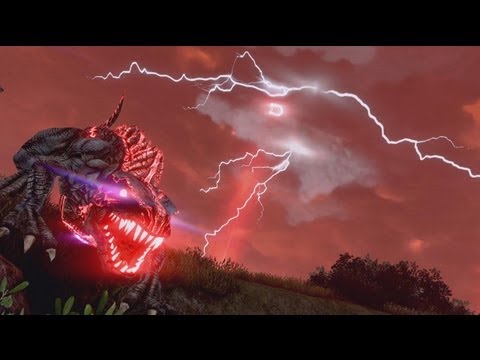
The creatures that give the game its name are not simply large enemies waiting to be shot.
Blood Dragons roam the island as enormous cybernetic predators. They are extremely dangerous to Rex, but they can also attack Omega Force soldiers.
That creates opportunities to use them rather than fight them directly.
Rex can remove cyber-hearts from dead cyber-soldiers. Throwing one attracts a Blood Dragon towards its location, which means the creature can effectively be directed towards enemy positions.
The relationship is wonderfully simple:
kill cyber-soldiers, collect their hearts, then feed their artificial organs to a giant neon dinosaur.
It fits the game perfectly.
More importantly, it adds another tactical option to garrison encounters. Instead of personally eliminating every soldier, I could introduce a Blood Dragon into the situation and let the resulting chaos do some of the work.
The creatures are therefore both enemies and environmental weapons.
That makes them far more interesting than a conventional boss-style monster and gives Blood Dragon one gameplay mechanic that genuinely changes the familiar Far Cry 3 structure.
Automatic Skills Simplify Progression
Character progression is much less flexible than it was in Far Cry 3.
Jason Brody’s abilities were organised through skill trees that allowed the player to choose which upgrades to unlock. Rex instead receives predetermined abilities automatically as his level increases.
That removes some control over character development.
Normally, I would consider losing that choice a significant weakness. Here, the simplified system fits the smaller scope reasonably well.
Blood Dragon isn’t trying to build another enormous progression system. It wants Rex to become an increasingly ridiculous cybernetic killing machine as quickly as possible.
Weapons can also be improved by completing activities and finding collectibles, giving exploration a practical purpose beyond completion percentages.
The result is progression that feels faster and more directed than Far Cry 3, even if it offers less opportunity to shape Rex around a particular playstyle.
Combat Still Benefits From Far Cry 3’s Freedom
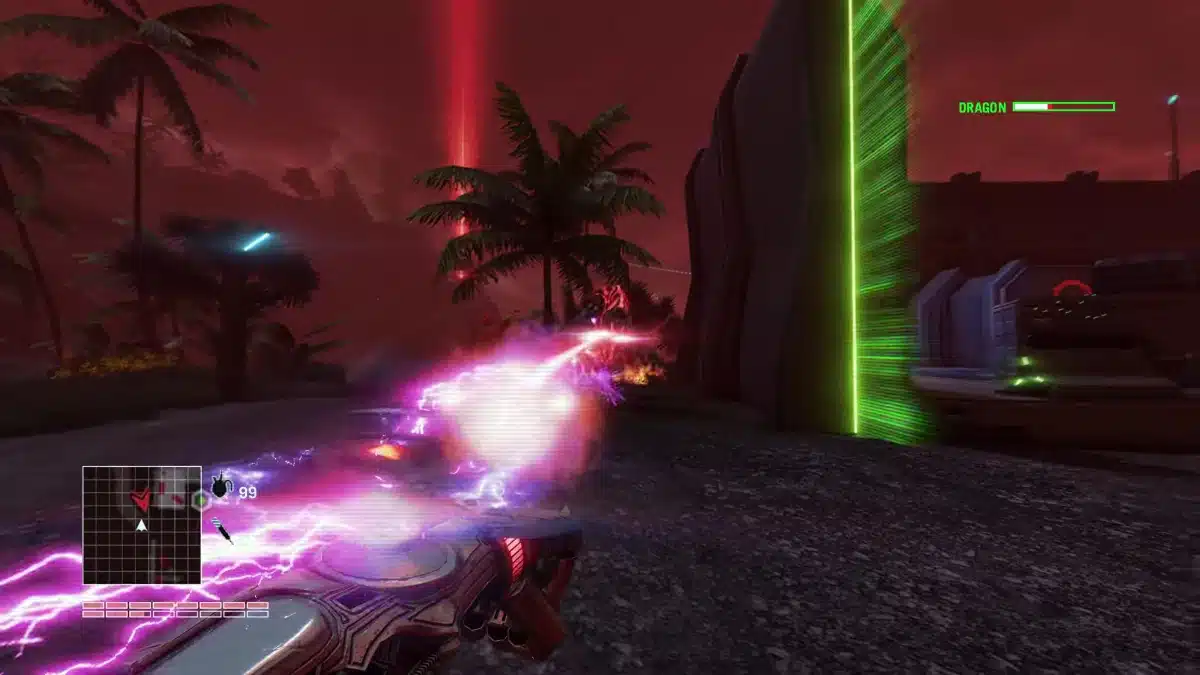
The shooting, stealth and takedown systems inherit much of their foundation from Far Cry 3.
That is generally good news.
Silenced weapons can support stealth, explosives can turn encounters chaotic and Rex’s enhanced movement lets him cover ground quickly. Combining those systems with garrisons and roaming Blood Dragons creates plenty of opportunities for improvised combat.
The original GLN review criticised the shooting for feeling weaker than Far Cry 3, and I still think the smaller selection of encounters can make combat feel less varied over time.
The difference is more about context than fundamental mechanics.
Blood Dragon is at its best when its systems collide. A straightforward firefight is less memorable than infiltrating a garrison, attracting a Blood Dragon and watching the encounter collapse into complete chaos.
That is where the game separates itself from the experience it was built upon.
The Synthwave Soundtrack Completes the World
The soundtrack was one of the most distinctive I’d heard in quite a while.
I liked that it didn’t rely on huge orchestral music or constantly try to force an emotional response. Instead, I felt the electro synthwave soundtrack completely committed to the game’s vision.
Power Glove’s score uses electronic rhythms and synthesised sounds that belong naturally alongside the neon landscapes, VHS imagery and exaggerated action.
That commitment matters because Blood Dragon could easily have become a collection of disconnected retro references.
It doesn’t.
The soundtrack, pixel-art cinematics, dialogue, collectibles, colour palette and story all seem to understand the same joke.
For me, that cohesion is what elevates the presentation beyond parody. The developers didn’t simply reference the 1980s and early 1990s. They built almost every part of the experience around their interpretation of that era.
PC Graphics and Performance
The PC version uses the same Dunia 2 technology underlying Far Cry 3, but completely transforms its presentation through heavy use of neon lighting, dark environments and stylised visual effects.
It supports both DirectX 9.0c and DirectX 11 rendering paths. The Windows version also provides configurable resolution and graphics options, while controller support was included alongside keyboard and mouse input.
I don’t have surviving benchmark measurements from my original playthrough, so I am not attaching an historical GLN frame-rate figure to the review.
The Windows edition provides substantially more graphics configuration than the original console versions, with separate DirectX rendering paths and adjustable image-quality options. Its documented PC capabilities and original requirements include:
| PC Feature | Far Cry 3: Blood Dragon |
|---|---|
| Graphics API | DirectX 9.0c / DirectX 11 |
| Resolution | Configurable |
| Graphics quality | Configurable |
| V-Sync | Supported |
| DirectX 11 rendering | Supported |
| Keyboard and mouse | Supported |
| Controller support | Supported |
| Original minimum VRAM | 512 MB |
| Original PC storage requirement | 3 GB |
| Original minimum RAM | 2 GB on Windows XP; 4 GB on later supported Windows versions |
| Original recommended RAM | 8 GB |
The game’s age is more obvious technically today, but the visual identity has held up remarkably well.
Raw texture quality matters much less when the entire world is deliberately covered in darkness, scanlines, glowing grids and aggressive neon. Its art direction does far more of the work than graphical fidelity alone.
That is another reason Blood Dragon remains immediately recognisable.
A Smaller Far Cry With a Stronger Identity
Blood Dragon doesn’t have the breadth of Far Cry 3.
Its world is smaller, progression is simplified and repetition becomes more noticeable because there are fewer activities and environments supporting the experience.
Yet judging it purely by the amount of content misses what makes it interesting.
This is a standalone expansion that uses an existing game’s systems to pursue an entirely different creative idea. Ubisoft Montreal didn’t need to rebuild Far Cry 3’s shooting, stealth and open-world structure. It needed to give those systems a reason to feel different.
For me, the personality accomplishes that.
I remember the synthwave soundtrack. I remember the absurd dialogue. I remember those pixel-art cutscenes and the VHS tapes and CRT televisions scattered throughout the world. Most of all, I remember how completely the developers committed to something that could easily have been dismissed as a joke.
That commitment gives Blood Dragon considerably more character than its relatively small scale suggests.
Its influence has also lasted longer than the hardware generation it originally appeared on. Ubisoft subsequently brought the game to newer consoles as Far Cry 3: Blood Dragon Classic Edition, and Blood Dragon later received 60fps support on current-generation consoles as Ubisoft continued updating older Far Cry releases.
The original PC version remains a strange little offshoot of the series.
It isn’t Far Cry 3 with a different colour palette, and it doesn’t need to be. It is a compact standalone experiment built from familiar mechanics, carried by a soundtrack, visual style and sense of humour that are entirely its own.
More than a decade later, that creative freedom is still the thing I remember most.
Far Cry 3: Blood Dragon Quick Facts
Developer
Ubisoft Montreal
Publisher
Ubisoft
Reviewed platform
Microsoft Windows (PC)
PC Release Date
1 May 2013
Type
Standalone expansion / spin-off
Genre
First-person shooter
Game Mode
Single-player
Engine
Dunia 2
Graphics API
DirectX 9.0c / DirectX 11
Controller support
Yes
Original PC storage requirement
3 GB
Far Cry 3: Blood Dragon

Far Cry 3: Blood Dragon takes almost everything serious about Far Cry 3 and fires it through a neon-soaked parody of 1980s action and science-fiction films.
Product Brand: Ubisoft
8
Pros
- Brilliant neon-soaked 80s sci-fi parody with a strong identity.
- Synthwave soundtrack, pixel-art cutscenes and retro presentation all work brilliantly together.
- Open-world Far Cry gameplay still feels flexible and fun.
- Blood Dragons add a clever tactical twist to garrison encounters.
- Shorter length and smaller scale help the joke stay fresh.
- PC version offers flexible graphics settings and solid input support.
Cons
- Repetition becomes noticeable because of the smaller world and activity set.
- Progression is simplified compared with Far Cry 3’s skill trees.
- Shooting can feel less varied than in the main game.
- Some familiar Far Cry mechanics are still doing most of the heavy lifting.
- The visual style does a lot of work, but the age of the underlying tech can still show.