
Key Highlights:
- Fight Night Champion was developed by EA Canada over 18 months and released for PlayStation 3 and Xbox 360 in March 2011.
- Champion Mode introduced a darker cinematic story centred on Andre Bishop, helping Fight Night Champion become the first EA Sports game to receive an ESRB Mature rating.
- EA used professional boxers during development, with Manny Pacquiao consulting on the game’s mechanics and feel while David Haye took part in motion-capture production.
Quick Links:
Released in March 2011, Fight Night Champion was EA Canada’s fifth and final mainline Fight Night game, combining physics-based boxing with the cinematic Champion Mode story and a darker presentation than previous entries.
EA developed the game as the successor to 2009’s Fight Night Round 4, but Fight Night Champion was designed to do more than refine the existing boxing formula. The development team introduced a new punching system, expanded its physics and animation technology, and built a narrative-driven single-player campaign around fictional boxer Andre Bishop. EA announced the game publicly in July 2010 and described it as a new direction for the franchise.
More than 15 years later, Fight Night Champion remains the final EA boxing game released to date.
How Fight Night Champion Was Developed
Fight Night Champion was developed by EA Canada in Vancouver over approximately 18 months, with much of the technology and development experience carried forward from Fight Night Round 4.
EA retained the physics-based foundation of its predecessor while improving locomotion, punching, stamina, boxer models and physical damage. The studio also introduced Full Spectrum Punch Control, which simplified right-stick punch inputs while expanding the number of punches available from the control system.
Champion Mode proved considerably more ambitious than simply improving the boxing engine.
Lead gameplay designer Brian Hayes described its production as closer to making a film than a conventional sports mode. Creating it required scriptwriting, actors, location work, filming, motion capture, animation, lip-syncing and sound production.
The result was a structured story following Andre Bishop from amateur boxing through prison fights, professional competition and his rivalry with Isaac Frost.
Professional Boxers Helped Shape the Game
EA worked with professional and amateur boxers while developing Fight Night Champion to improve the authenticity of its movement, animations and presentation.
Manny Pacquiao consulted on the game’s mechanics and feel, while his likeness and fighting style were also represented as part of Fight Night Champion’s licensed roster.
Another world champion had a more visibly documented role in production.
David Haye participated in motion-capture work for Fight Night Champion, with EA releasing behind-the-scenes footage showing the British heavyweight being captured for the game. EA’s surviving production page specifically identifies Haye as part of the motion-capture process.
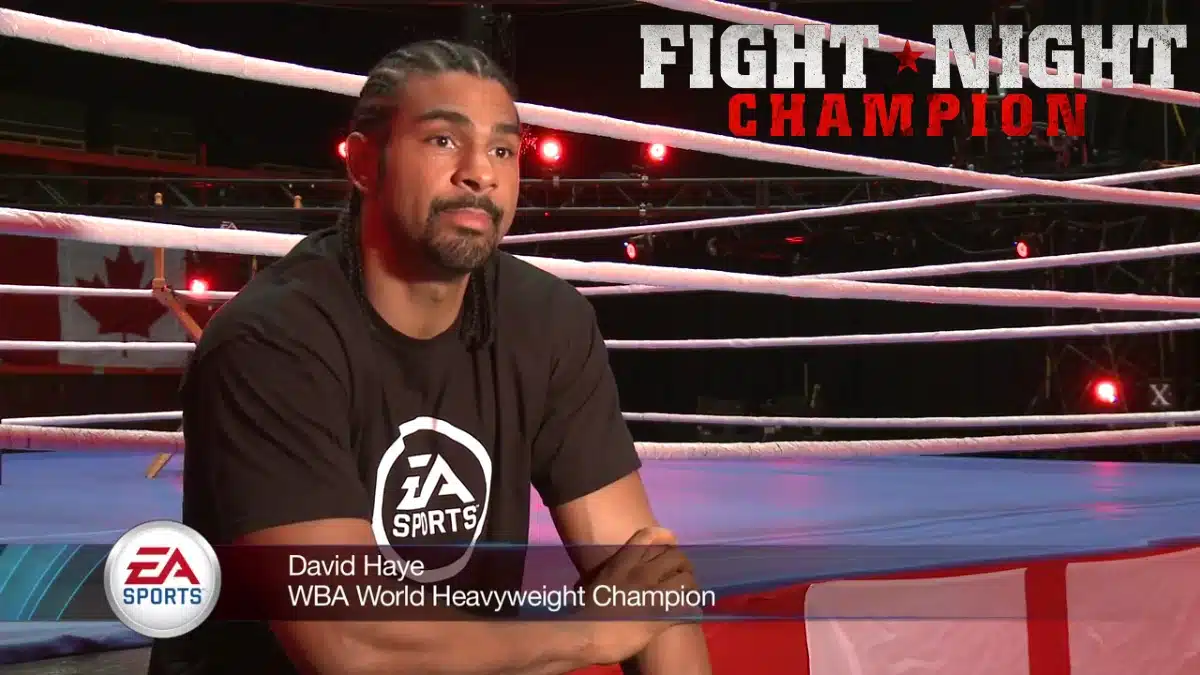
EA Canada also used experienced amateur boxers for extensive animation capture. Developers described recording hundreds of punch animations over intensive motion-capture sessions, giving the animation team reference material for different punches and boxing styles.
This combination of professional boxer involvement, motion capture and physics-based animation helped give Fight Night Champion a distinctive movement system rather than relying entirely on manually created boxing animations.
Why Champion Mode Was Different
Champion Mode gave Fight Night Champion a cinematic single-player story rather than relying exclusively on traditional career progression.
The campaign follows Andre Bishop through a scripted boxing story involving his amateur career, imprisonment, professional comeback and conflict with promoter D.L. McQueen.
Individual fights also changed the normal rules and objectives.
Some bouts required Bishop to protect an injury, target specific areas of an opponent or survive difficult rounds before being allowed to fight normally. Contemporary reviews highlighted these changing objectives as one of the features that separated Champion Mode from a standard sequence of boxing matches.
The story also allowed EA to portray boxing more violently than previous Fight Night games.
Fight Night Champion received an M for Mature 17+ rating from the ESRB in North America, while the European release was rated PEGI 16. The ESRB cited blood, violence, strong language and suggestive themes, making Fight Night Champion the first EA Sports title to receive a Mature rating.
The darker presentation was deliberate. When EA announced Fight Night Champion in July 2010, the company said it wanted the game to convey more of boxing’s brutality while changing expectations for a single-player sports game.
Fight Night Champion’s Gameplay Changes

Fight Night Champion retained the physics-driven boxing foundation of Fight Night Round 4 while changing several important systems.
The biggest addition was Full Spectrum Punch Control.
Instead of requiring the more elaborate analogue-stick movements used by the previous Total Punch Control system, players could throw different punches using directional flicks. Face-button punching was also available.
EA said the redesigned system offered twice as many punch possibilities as the previous analogue implementation while reducing the complexity of performing them.
The physics and animation systems were also refined to improve movement, punching, stamina and visible damage.
EA’s technology extended beyond punches themselves. Developers worked on more realistic muscle and body deformation, boxer proportions and physical reactions to punches, contributing to the visual damage that became one of Fight Night Champion’s defining characteristics.
How Fight Night Champion Was Received
Fight Night Champion received strong reviews when it launched in 2011.
The PlayStation 3 version holds a Metascore of 84, while the Xbox 360 release scored 86. Critics frequently praised the presentation, boxing mechanics and Champion Mode, although opinions were more divided over some of the changes to the control system.
Champion Mode was particularly important to the game’s identity because it gave reviewers something fundamentally different to discuss compared with previous Fight Night releases.
GameSpot praised the changing situations imposed throughout the campaign and the way fights forced players to adapt rather than simply repeat the same approach against every opponent.
Fight Night Champion has also aged unusually well for a sports game.
When I revisited the game for my Fight Night Champion Xbox Series X review, I gave it 9.5/10. More than a decade after release, the boxing mechanics, animation and presentation remain strong enough that the game still feels competitive with much newer boxing titles.
Fight Night Champion’s Lasting Legacy
Fight Night Champion remains the final mainline Fight Night game more than 15 years after its original release.
EA continued supporting the game after launch through updates and downloadable content, although active development eventually ended. GLN’s Fight Night Champion patch history documents the updates released during the game’s supported period.
Its longevity has been helped considerably by Xbox backwards compatibility. Fight Night Champion was added to the Xbox One backwards-compatible library in 2018 and remains playable on later Xbox hardware.
The absence of a sequel has also strengthened its position within boxing games. While other boxing titles have appeared since 2011, EA has never released Fight Night Champion 2 or another mainline Fight Night entry.
There have, however, been signs of movement around the franchise. Reports surrounding development of a new Fight Night game have kept interest in an eventual EA boxing revival alive.
Until that happens, Fight Night Champion remains both the final Fight Night release and, in my view, one of the strongest boxing games ever made.
If you’re still playing, the Fight Night Champion Guide brings together GLN’s current guides, gameplay systems and reference material for the game.