Key Highlights:
- NEVER HAPPENED gives players 180 seconds to repaint damaged sections of 100 real public-domain artworks before an inspector arrives.
- Each restoration is machine-scored against the original painting, with a heatmap showing exactly where the player went wrong.
- The full release adds Daily Challenges, worldwide leaderboards and online competitive rooms for up to four players.
Japanese indie studio SF Create has confirmed that NEVER HAPPENED will launch on Steam later this month, turning the restoration of damaged masterpieces into a three-minute score attack.
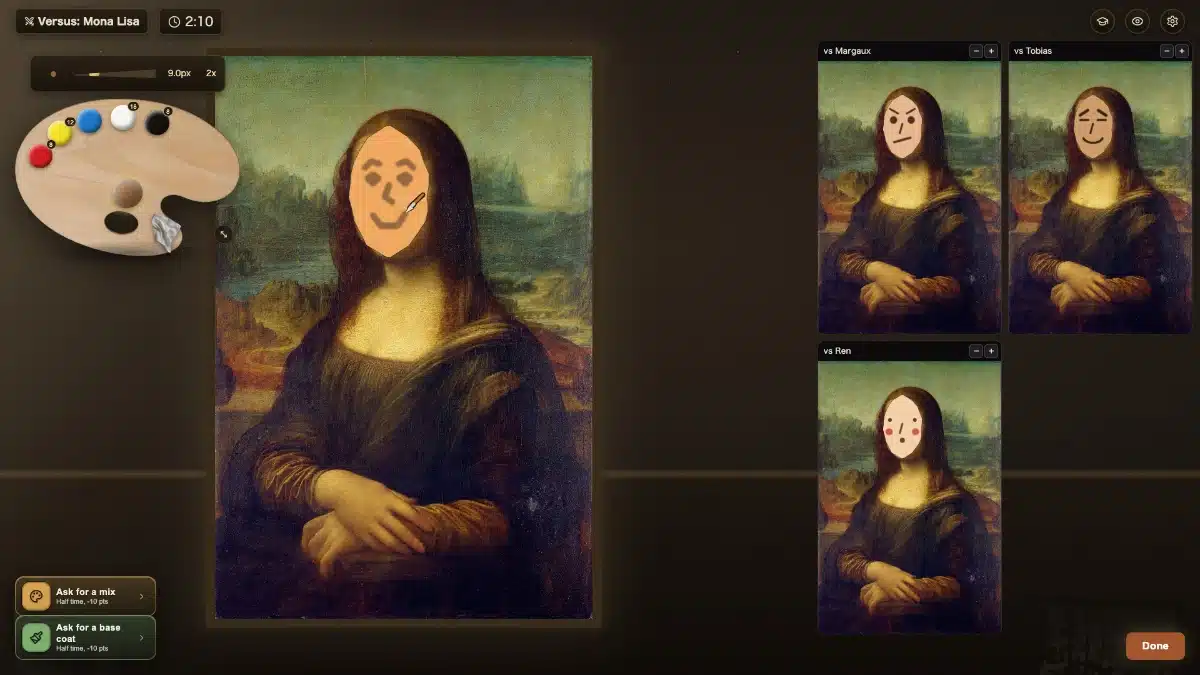
Players become Vince Lang, a failed painter who now transports valuable artwork for a living. When one of those paintings is accidentally torn, the company’s solution is considerably less professional than admitting what happened: repaint the missing section before an inspector arrives.
Every attempt gives Vince exactly 180 seconds. Players must examine the surviving colours, mix paint manually on a palette and recreate only the damaged part of the canvas. Digital restoration tools are deliberately excluded from the process.
The finished game will contain 100 real paintings, more than double the 42 works originally planned when NEVER HAPPENED was revealed. SF Create says each piece uses a high-resolution scan of a genuine public-domain original rather than a recreation produced specifically for the game.
That distinction becomes part of the scoring system.
Once the three-minute timer expires, the game compares the player’s work against the original painting and produces a percentage match score. A heatmap then highlights inaccurate areas before displaying the original artwork, its damaged state and the player’s finished repair side by side.
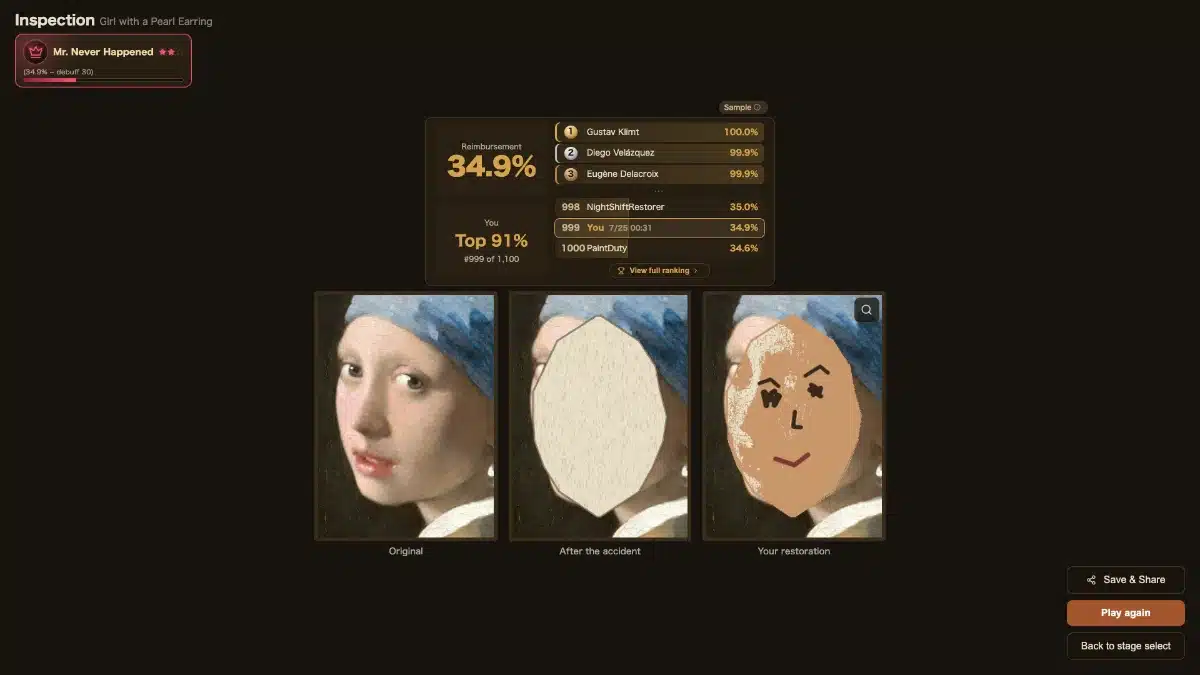
Players can save the resulting comparison as an image or video, including particularly disastrous attempts. SF Create has also explicitly permitted monetised streams, recorded videos, Shorts and other gameplay coverage without requiring prior permission.
I think the scoring system is what turns NEVER HAPPENED from an amusing art premise into something with genuine replay value. The player is not simply asked whether a restoration looks convincing. The game measures it against the source artwork and exposes the mistakes afterwards.
Competitive modes extend that idea beyond individual runs.
A Daily Challenge gives every player the same one-attempt restoration, with results placed on a worldwide leaderboard. Online rooms support up to four players competing directly to produce the strongest repair. Steam also lists single-player, online PvP, Steam Achievements and Steam Workshop support.
| NEVER HAPPENED feature | Confirmed detail |
|---|---|
| Restoration time | 3 minutes / 180 seconds |
| Paintings | 100 real public-domain works |
| Scoring | Percentage match against original |
| Error analysis | Restoration heatmap |
| Daily mode | One-shot Daily Challenge |
| Multiplayer | Online competition for up to 4 players |
| Platforms | Windows and macOS |
| Languages | 6 |
There is an interesting regional wrinkle around the release date. SF Create’s Japanese announcement gives August 20, 2026 as the launch date, while Steam currently displays August 19 to users in some regions. That appears to reflect the same Steam release occurring across different time zones rather than two separate launches.
The Japanese release announcement also confirms a price of ¥530, with a 20% launch discount planned for the first ten days. Regional Steam prices have not yet been displayed on the UK storefront.
NEVER HAPPENED supports Windows and macOS, but the Mac requirements carry an important restriction. The macOS version requires Apple Silicon, beginning with the M1 processor, and does not support Intel-based Macs.
PC requirements are considerably lighter. SF Create lists Windows 10, a 2GHz dual-core processor, 4GB RAM, integrated Intel HD 4000-class graphics and only 500MB of available storage as the minimum specification.
Steam also contains an unusually specific AI-content disclosure.
SF Create says none of the 100 featured masterpieces is AI-generated. The paintings come from digitised public-domain originals. Generative AI was instead used for some other artwork, including parts of the interface, characters and backgrounds, alongside some audio and localisation work.
That clarification is particularly relevant for a game whose central selling point is interacting with real historical artwork. The source paintings themselves remain genuine digitised works even where generative tools contributed elsewhere in production.
NEVER HAPPENED supports English, Japanese, Russian, Simplified Chinese, Traditional Chinese and Korean interfaces and subtitles at launch.
For a small simulation game, its central loop is unusually easy to explain: damage a priceless painting, get three minutes to hide the evidence, then let the game calculate exactly how convincing the cover-up was.