
Key Highlights:
- Rainbow Six Tactics is a single-player turn-based game launching in 2027 for PS5, Xbox Series X|S and PC, with cloud versions also confirmed.
- Rainbow Six: Vegas 2 protagonist Paul Bishop returns as Six, commanding squads of four from 15 familiar Siege Operators.
- Ubisoft Paris is building a campaign with more than 45 locations, destructible environments, optional permadeath and no live-service structure or microtransactions.
Ubisoft has officially revealed Rainbow Six Tactics, a new single-player strategy game that trades Siege’s first-person gunfights for turn-based squad combat when it launches in 2027.

The Gamescom Opening Night Live reveal also brings back a character absent from the starring role for almost two decades.
Players take control of Paul Bishop, the protagonist of Rainbow Six: Vegas 2. Bishop has become Six, commander of Team Rainbow, and now directs operations rather than fighting through them from a first-person perspective.
That makes Tactics the first new Rainbow Six single-player campaign since Vegas 2 launched in 2008. Ubisoft also describes it as the first time players have directly occupied the role of Six within the franchise.
Its story is not separate from Rainbow Six Siege.
Ubisoft Paris has worked with the Siege team in Montreal to place Tactics between Year 10 and Year 11 of Siege’s narrative. Rainbow has been destabilised and must be rebuilt after the organisation faces a new global conspiracy.
The enemies are connected to the Keres Legion, the organisation already established within Siege’s current storyline.
That makes Tactics more than a strategy spin-off borrowing recognisable character models. It is being used to connect events surrounding Rainbow’s collapse and subsequent reconstruction within the existing canon.
Siege itself continues independently. Its Operation Split Fire season launches on September 1 with Defender Noor, while Tactics develops another part of the same wider timeline.
Gameplay begins at Rainbow headquarters rather than on the battlefield.
Players review intelligence, select an assignment and construct a squad from 15 Operators taken from Rainbow Six Siege.
Only four Operators deploy during an individual mission.
Ubisoft has confirmed characters including Ash, Sledge, Nøkk and Montagne, while pre-release demonstrations have also shown familiar faces such as Doc, Glaz, Finka, Twitch and Zofia. Each Operator keeps specialised equipment and receives an individual skill tree adapted to the turn-based format.
Squad composition therefore determines more than weapon choice.
A reconnaissance specialist can expose threats before entry. Breaching Operators can create new routes into a building, while different gadgets can alter sightlines, cover and enemy positioning.
The mission itself begins before conventional turn-based combat starts.
Players deploy drones during a real-time reconnaissance phase to reveal enemies, traps, supplies and parts of the environment hidden by fog of war.
They then choose how the squad will enter.
Rainbow Six Tactics uses a dedicated Breach system that allows Operators to take positions around doors, windows and destructible walls before a synchronised assault.
Players assign individual actions before triggering the breach. Operators then execute those commands together, temporarily breaking the normal turn-by-turn structure.
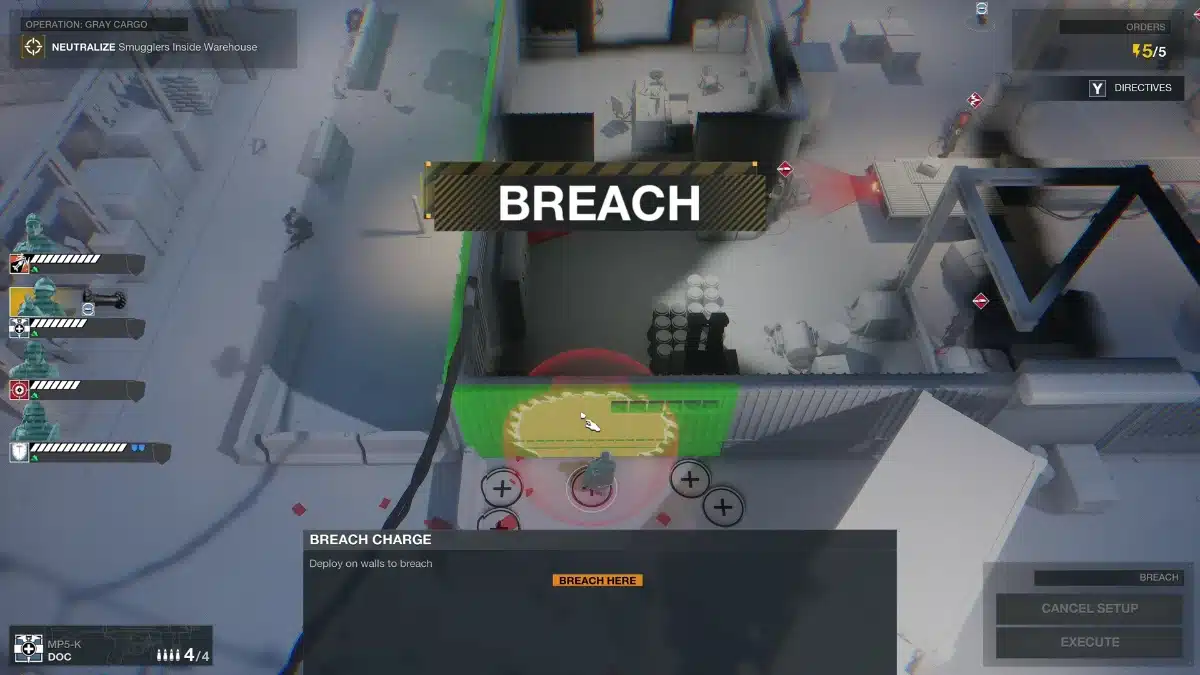
I think this is the mechanic that most clearly separates Tactics from simply placing Siege Operators inside an XCOM-style combat grid, because Rainbow’s traditional recon-to-breach sequence becomes the opening tactical problem rather than flavour around the edges.
Once the breach ends, combat returns to turns.
Positioning, lines of sight and cover become central, alongside familiar tactical concepts such as overwatch. Operator abilities can then be combined with the environment to change how a fight develops.
Destruction remains a core system.
Walls can be broken to open new entry points. The same destruction can create new lines of sight or remove cover protecting an enemy.
That means a wall is not merely scenery with a destruction animation attached. Its state can alter movement, visibility and attack opportunities during the tactical encounter. Ubisoft explicitly identifies environmental destruction as one of the systems carrying Siege’s tactical identity into the new genre.
Ubisoft currently lists more than 45 locations around the world.
Mission objectives include Hostage Rescue, Bomb Disposal and Target Elimination. Official material shows locations ranging from urban areas and airports to warehouses and offshore oil platforms.
Additional developer briefings reveal another important distinction.
The environments are handcrafted rather than procedurally generated. Randomisation can change variables such as enemy positions, bombs and hostages, but Ubisoft Paris has built the underlying locations manually.
That should allow the same environment to support different tactical situations without rebuilding the entire battlefield algorithmically on every mission.
HQ management continues after the squad returns.
Players can train Operators, develop their skills, customise loadouts and improve departments within Rainbow’s base.
Operator health also persists between assignments.
That becomes considerably more important for players who enable optional permadeath.
Game director Martial Potron confirmed that a severely injured Operator can become permanently unavailable for the remainder of a campaign when permadeath is active.
The option is separate from difficulty.
Players can therefore enable permanent losses even while using an easier combat setting. Rainbow Six Tactics also includes an Ironman mode for players who want campaign decisions and casualties to carry greater consequences.
Losing an Operator would consequently alter future squad construction rather than simply triggering a reload.
That matters when each of the 15 characters has unique equipment and progression. A heavily upgraded specialist disappearing late in the campaign could remove an established tactical combination and force the player to develop someone else.
Rainbow Six Tactics is also taking an unusually traditional approach to monetisation for a modern Ubisoft release.
Ubisoft Paris has told media attending its reveal briefing that the game is fully single-player, is not designed as a games-as-a-service title and will contain no in-game store or microtransactions.
That does not establish whether conventional expansions or DLC could be sold later.
It does establish that the base game is being presented as a self-contained campaign rather than another ongoing Rainbow Six service.
The platform situation is also considerably broader than early reporting suggested.
Rainbow Six Tactics is confirmed for PlayStation 5 and Xbox Series X|S.
PC players will be able to get it through Ubisoft Connect, Steam and the Epic Games Store. Ubisoft has also confirmed GeForce Now and Blacknut support, while Ubisoft+ is listed among its availability options.
There is currently no announced PS4 or Xbox One version.
Ubisoft has not announced a specific 2027 release date, price, editions or preorder bonuses. The Steam page can already be wishlisted and currently lists Windows 11 as both its preliminary minimum and recommended operating system, with the remaining PC requirements still absent.
The reveal also resolves one of the unknown slots surrounding Ubisoft’s Gamescom plans.
Before Opening Night Live, the company’s Gamescom 2026 schedule contained several unnamed presentations alongside a Saturday Rainbow Six session titled Bridging Worlds and Stories.
That title now makes considerably more sense.
Rainbow Six Tactics is attempting to bridge two generations of the franchise at once: Siege supplies the Operators, gadgets, destruction and current narrative, while Paul Bishop and the single-player command structure reconnect it with the series that existed before Siege became Ubisoft’s dominant Rainbow Six platform.
For a franchise now associated overwhelmingly with multiplayer competition, the most significant part of the announcement may therefore be what Tactics is not.
It is not a Siege replacement, another competitive playlist or a new live-service platform.
It is Ubisoft’s first dedicated Rainbow Six single-player campaign in nearly two decades, with the player finally occupying the commander’s chair.