Star Wars films are very good at arriving somewhere important.
A Star Destroyer enters the frame. A Jedi walks into a throne room. A rebellion reaches the battle that may decide the fate of the galaxy. Someone discovers that a member of their family tree has once again made life unnecessarily complicated.
Then the film moves on.
It has to. Movies are built around momentum. They cannot spend forty minutes explaining who services the X-wings after Yavin, how smugglers actually make a living on the Outer Rim, what happens to a planet after the Jedi leave, or whether anyone on the Death Star ever filed a workplace complaint about the lack of railings.
Games can.
That may be one of the most useful things Star Wars video games have contributed to the franchise over more than four decades. They do not simply recreate the moments the films already showed us. At their best, they stay behind after the camera would normally cut away.
They turn background into a place.
Quick Links:
X-Wing made the Rebellion feel like an organisation
The original trilogy tells us that Rebel pilots matter, but it mostly meets them when something important is already happening.
X-Wing in 1993 gave players the less glamorous part.
Briefings. Mission objectives. Escort duties. Patrols. Power management. Identifying targets. Deciding whether shields or engines need the energy more urgently while somebody in a TIE fighter is attempting to shorten your career.
That changes the Rebellion.
In the films, an X-wing is a beautiful shape flying through a battle. In the game, it becomes equipment. You learn its limits. You understand why pilots need training, why squadrons matter and why a capital ship appearing on the wrong side of the radar can ruin an otherwise pleasant afternoon.
TIE Fighter did something even more interesting by applying the same idea to the Empire. Instead of reducing Imperial pilots to anonymous helmets that explode on cue, it showed the military from inside. Orders arrive. Objectives conflict. Officers have agendas. The player begins to understand how an enormous authoritarian machine can look perfectly normal when your job is simply to complete today’s assignment.
The films show wars through decisive moments.
Games can show the shifts in between.
KOTOR II was interested in what happened after the heroic ending
Star Wars films also tend to leave once the victory has happened.
The Death Star explodes. The music rises. Everyone looks relieved.
Roll credits.
KOTOR II begins with the much less comfortable question: what if the consequences are still there?
Obsidian’s sequel takes place in a galaxy damaged by wars that, from the perspective of a more conventional Star Wars story, could easily have been presented as heroic history. Instead, planets, soldiers, Jedi and ordinary people are still carrying the results around with them.
Nar Shaddaa is full of refugees. Dantooine remembers what happened to the Jedi. Veterans do not all agree on what the wars meant. Even the player character’s history is less about a glorious past than about something the galaxy has not finished processing.
This is an area where games have an enormous structural advantage.
A film can tell us a war was devastating.
A role-playing game can make us walk through the places that are still devastated twenty hours later.
It can introduce people who were nowhere near the climactic battle but still lost their homes because of it. It can make political history feel like something that happened to actual lives rather than another paragraph in an opening crawl.
Sometimes the most interesting Star Wars story begins after the medals have already been handed out.
Star Wars Galaxies turned the background characters into the point
No game pushed this idea further than Star Wars Galaxies.
The films are filled with people whose existence is mostly decorative. Cantinas have entertainers. Settlements have traders. Somebody presumably builds droids, repairs moisture vaporators, manufactures weapons and provides food to all those Rebel bases that appear to contain thousands of people but very few kitchens.
Galaxies asked what would happen if those people were the game.
You could become an entertainer, crafter, merchant, doctor or creature handler. Player cities appeared. Economies formed. A cantina could matter because actual players had reasons to be there rather than because Han Solo happened to need a table for five minutes.
That is a profoundly different way of building Star Wars.
The films naturally organise the universe around protagonists. If Luke walks into Mos Eisley, Mos Eisley briefly exists because Luke needs something from it.
An MMO can reverse that relationship.
Mos Eisley exists whether you are important or not.
That makes the galaxy feel much larger.
And when looking across more than forty years of Star Wars video games, this is one of the recurring strengths of the medium: games are unusually good at taking something that occupied six seconds of screen time and asking whether an entire form of play might be hiding inside it.
Sometimes the answer is an MMO profession.
Sometimes it is podracing.
Star Wars has always had a lot of background.
Games have simply been better at noticing it.
Battlefront makes the anonymous soldier visible

The same thing happens on a battlefield.
Star Wars movies need named heroes. Battles are framed around Luke, Han, Leia, Anakin, Obi-Wan or whichever person currently has the highest narrative insurance policy.
Thousands of other people are present.
They rarely get the camera.
The original Battlefront games understood that being one of those people was itself an interesting fantasy. You were not necessarily the Jedi leading the charge. You could simply be the clone trooper standing thirty metres behind him, carrying a blaster and discovering that heroic destiny offers surprisingly little protection against an incoming thermal detonator.
That shift in perspective matters.
Games Latest News’ coverage of the Battlefront Classic Collection highlighted how much of the original games was built around planetary battles, classes, vehicles and large groups of ordinary combatants rather than a constant parade of heroes.
The result is a version of Star Wars warfare that feels less choreographed.
You can lose the position.
The famous character can die.
A battle can be decided because three anonymous players remembered to capture the command post while everyone else was busy trying to be Darth Maul.
Cinema makes war dramatic.
Games make it procedural.
There is value in both.
Outlaws is more interesting when nobody cares who Kay is

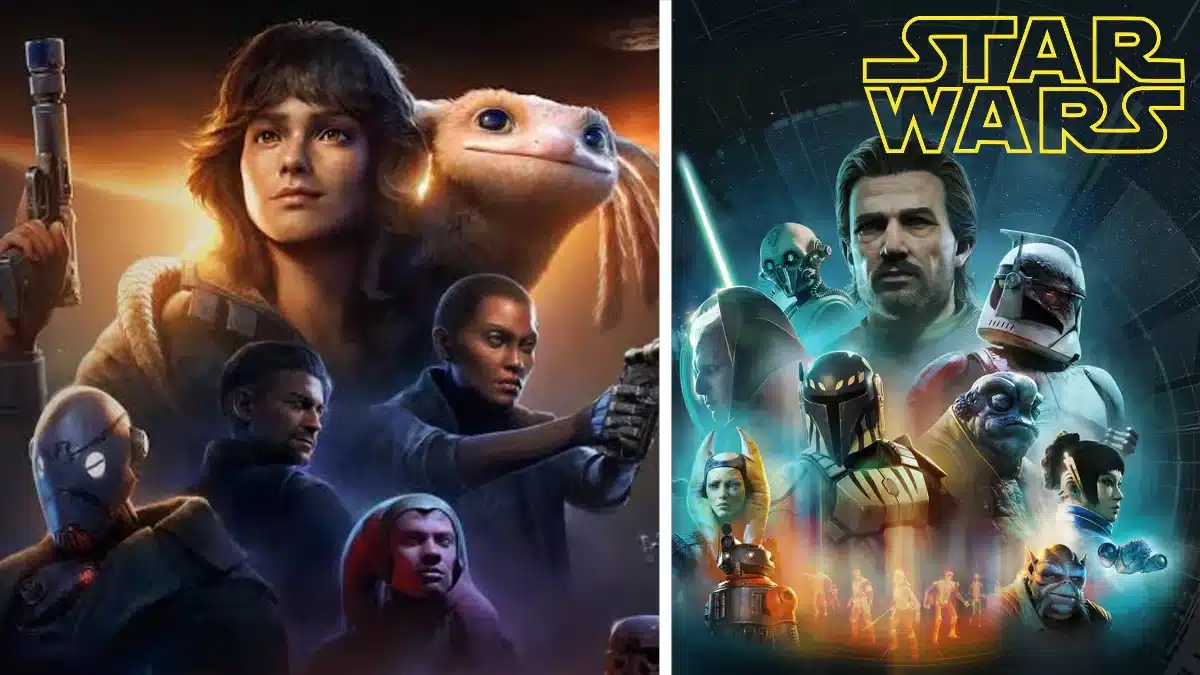
Star Wars Outlaws works from another piece of neglected background: the criminal economy.
The films tell us repeatedly that the galaxy is full of smugglers, bounty hunters, crime syndicates and people who have somehow managed to owe Jabba the Hutt money.
They rarely have time to explain what living inside that world actually feels like.
Kay Vess can.
Her value as a protagonist is partly that most of the galaxy does not particularly care about her. She is not arriving to fulfil an ancient prophecy. She needs money, contacts, reputation and a way out of whatever problem she created ten minutes earlier.
That allows the factions around her to become more than scenery.
A syndicate is no longer simply a group whose logo appears behind a villain. It becomes an organisation whose opinion of you affects where you can go and how comfortably you can operate there.
GLN’s coverage of Outlaws joining Xbox Game Pass describes the game as Kay hustling across planets and crime syndicates, and “hustling” may actually be the important word.
That is something films rarely have time for.
The hustle.
Star Wars movies show Han Solo after he has already become Han Solo.
A game can spend twenty hours explaining why being a smuggler is a profession rather than a leather jacket.
Zero Company can make the Clone Wars smaller
Zero Company arrives at the same idea from the opposite direction.
The Clone Wars are one of the largest conflicts Star Wars has ever depicted. Armies move between planets. Jedi generals command enormous forces. Battles can decide entire systems.
A tactics game does not need all of that on screen.
It needs the squad.
That smaller scale allows details to become important that would disappear inside a movie battle. Who goes on the mission? Which Operator works well with another? Who is wounded? Which part of the galaxy receives attention when the company cannot be everywhere at once?
The Clone Wars become less about watching thousands of identical soldiers charge across a battlefield and more about remembering that the six people standing behind nearby pieces of cover are not interchangeable.
This is another thing films struggle to do simply because of time.
Games can create attachment through repetition.
The character who survives one mission is there for the next one. A base becomes familiar because we return to it. Relationships matter because we have spent hours with them rather than because the screenplay has informed us that these people are now close friends.
A film has two hours to create history.
A game can let us accumulate it.
Games can afford to stay after the exciting part
This is why the best Star Wars games do not need to compete with the films at being films.
They have something the films do not.
Time.
They can make us fly the patrol before the famous battle. They can show the refugee after the war. They can let us manufacture the blaster that somebody else will eventually use. They can make us care about the anonymous clone, the mechanic, the smuggler or the squad member whose name will never appear in an opening crawl.
They can remain in a place long enough for it to stop being a set.
That does not mean Star Wars games should avoid Jedi, heroes or enormous conflicts. Jedi: Fallen Order and Survivor are obvious reminders that a focused character story can work brilliantly in games too.
But games become particularly valuable to Star Wars when they resist the temptation to recreate only the parts cinema has already made famous.
There are thousands of doors in the films that nobody opens.
Hundreds of ships whose crews we never meet.
Entire planets the heroes visit for ten minutes and then leave behind.
Someone still lives there after the Millennium Falcon takes off.
Games get to stay and find out who.
And sometimes that is where the galaxy becomes most interesting.