
Crysis 3 brings Crytek’s original trilogy to a close by returning to New York City, although the city Prophet finds is almost unrecognisable from the urban battleground of Crysis 2. By 2047, Prophet returns to a New York that has changed dramatically. CELL’s Liberty Dome covers the city, while nature has spread through its ruined streets and structures, creating a battlefield where urban remains sit alongside wetlands and heavy vegetation.
It is an ideal setting for what Crysis does best. The Nanosuit gives Prophet the freedom to approach combat through stealth, armour and overwhelming firepower, while the Predator Bow adds one of the most satisfying weapons in the series.
Crysis 3 was also an extraordinary technical showcase on PC when it arrived in 2013. Crytek pushed CryEngine 3 hard enough that even powerful gaming PCs could be tested by its highest settings, but the impressive part wasn’t simply how demanding it was. Vegetation, lighting, water, particle effects and the sheer density of the Liberty Dome created environments that looked considerably more sophisticated than most shooters of the period.
Quick Links:
Story and Characters
Crysis 3 takes place decades after Crysis 2 and puts players back inside the Nanosuit as Prophet.
New York has been enclosed beneath a huge Nanodome constructed by the CELL Corporation. What was presented as a way of containing the remaining Ceph threat has allowed CELL to establish control while exploiting alien technology for its own purposes.
Prophet is rescued early in the campaign by Michael “Psycho” Sykes, returning from the original Crysis and Crysis Warhead. Their relationship becomes an important part of the story.
Psycho is no longer wearing a Nanosuit, while Prophet has become increasingly difficult to separate from his. That contrast gives Crysis 3 a more personal thread beneath the usual conflict involving CELL and the Ceph.
The wider story eventually revolves around the Alpha Ceph and Prophet’s attempt to prevent an extinction-level threat.
The plot isn’t the main reason to play Crysis 3, and some of its science-fiction terminology can become difficult to follow without knowledge of the previous games. However, Prophet and Psycho give the campaign enough personality to hold its larger ideas together.
Gameplay and the Nanosuit
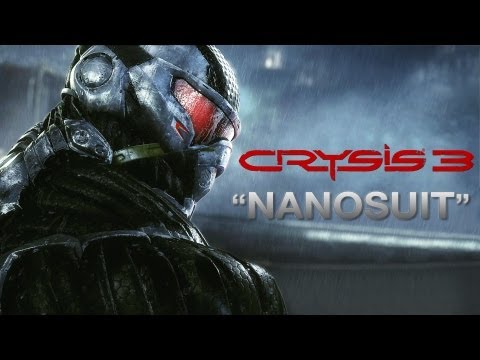
Calling Crysis 3 a conventional first-person shooter misses what makes its combat interesting.
Prophet’s Nanosuit allows encounters to shift between stealth and direct combat almost instantly. Cloak makes it possible to move through enemy positions largely unseen, while Armour increases protection when a quiet approach inevitably turns violent.
The Tactical Visor complements both styles. Enemies, weapons and useful objects can be marked before entering an area, allowing the player to study patrol routes and decide how to attack.
That freedom is particularly effective in the campaign’s larger environments.
An encounter can begin with Prophet observing CELL soldiers from a distance, hacking a turret and quietly eliminating isolated enemies before anybody knows he is there. The same encounter can end with Armour active, alien weaponry firing and half the environment exploding around him.
Weapon customisation adds another layer. Attachments can be changed without leaving the action, allowing weapons to be adapted to different ranges and situations.
Hacking is useful too. Turrets and other electronic systems can be compromised through the Nanosuit, turning CELL’s own equipment against its soldiers.
I found those systems at their best when they worked together. Crysis 3 gives you tools and lets you decide how much chaos you want to create.
The Predator Bow
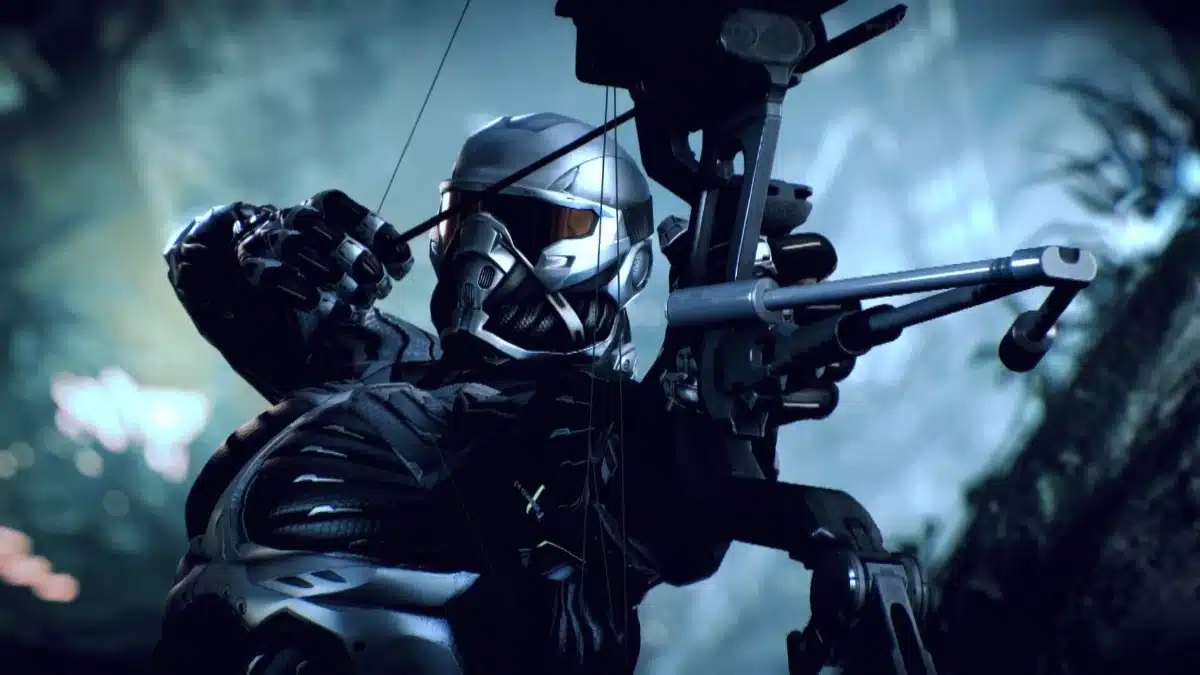
The Predator Bow deserves special attention because it fundamentally changes stealth.
Prophet can fire the bow while remaining cloaked. Conventional firearms generally compromise that advantage, but the bow allows enemies to be eliminated without immediately revealing his position.
Different arrow types broaden its usefulness beyond silent kills. Standard arrows are effective against infantry, while specialised ammunition gives Prophet options against tougher targets and groups.
Arrows can also be recovered from defeated enemies and the surrounding environment, encouraging careful players to reuse ammunition.
The weapon feels powerful without replacing the rest of Prophet’s arsenal.
During my original playthrough, I found using the bow considerably more satisfying than relying entirely on conventional firearms. Combining it with Cloak turns open areas into hunting grounds where enemies can be marked, separated and eliminated individually.
Few additions define Crysis 3 as effectively.
Level Design and the Liberty Dome
The Liberty Dome combines ideas from both previous Crysis games.
The original Crysis was known for large tropical environments that encouraged experimentation, while Crysis 2 moved the series into the streets and buildings of New York. Crysis 3 attempts to merge those identities by allowing nature to reclaim the city.
The result is visually striking.
Fields of tall grass sit beside ruined structures. Swamps and waterways cut through abandoned urban areas, while enormous sections of infrastructure remain visible beneath years of vegetation.
Crytek divided the Liberty Dome into seven distinct environments, helping the campaign move between different visual themes rather than presenting one continuous ruined city.
Crysis 3 isn’t as consistently open as the original game, and parts of the campaign funnel Prophet through more controlled sequences. Its larger combat spaces are much better because they give the Nanosuit room to matter.
When several routes, elevated positions, hackable systems and groups of enemies are present at once, the game becomes less about following a prescribed solution and more about creating one.
Enemy AI and Difficulty
Enemy behaviour is less convincing than the tools available to fight them.
During my playthrough, CELL soldiers could sometimes be manipulated into poor positions or eliminated using hacked turrets with relatively little resistance. Cloak could also make encounters surprisingly forgiving once its energy limitations were understood.
That doesn’t mean Cloak provides permanent invisibility. Nanosuit energy drains while it is active, forcing Prophet to manage movement and choose when to expose himself.
Higher difficulty settings naturally make mistakes more costly, but experienced players can still exploit the combination of Cloak, the Predator Bow and careful reconnaissance.
The Ceph provide a different challenge from CELL because their movement and abilities force the player to adapt rather than treating every encounter as another fight against human soldiers.
Even so, I found Crysis 3 more enjoyable for the freedom of its combat than for the intelligence of the enemies themselves.
Graphics and PC Performance
Crysis had already become synonymous with demanding PC graphics long before the third game arrived, and Crysis 3 continued that reputation.
The original PC release uses CryEngine 3 and requires DirectX 11 hardware. Crytek used that technology to create dense vegetation, detailed environments, sophisticated lighting and extensive environmental effects throughout the Liberty Dome.
What impressed me most during my original PC playthrough was that the game remained visually striking even without using its highest settings. I played with settings around the medium range and Crysis 3 still looked exceptional for 2013.
The PC version provides considerably more control than a simple collection of preset modes. Resolution, V-Sync, anti-aliasing and individual advanced graphics options can be configured around the performance available from the player’s hardware.
On PC, Crysis 3 provides extensive control over image quality and performance, with configurable resolution, multiple anti-aliasing techniques and individual advanced graphics settings. Here are the key technical capabilities of the original 2013 PC release:
| PC technical feature | Crysis 3 |
|---|---|
| Graphics API | DirectX 11 |
| Resolution | Configurable, including 4K |
| Frame rate | 60 FPS and 120+ FPS supported |
| Built-in frame-rate cap | None |
| V-Sync | Supported |
| Widescreen | Supported |
| Ultrawide | Supported |
| Multi-monitor | Supported |
| Anti-aliasing | FXAA, SMAA, MSAA, Nvidia TXAA |
| Anisotropic filtering | Up to 16x |
| Field of view | No conventional in-game slider |
| Original storage requirement | 17 GB |
There is an important distinction between supporting high frame rates and guaranteeing them. Crysis 3 was an exceptionally demanding game at higher settings, so actual performance depends heavily on GPU capability, resolution and graphics configuration.
The original game does not impose a conventional overall 60 FPS cap, allowing suitable PC hardware to run at considerably higher frame rates. Some individual simulation elements, including grass and water physics, operate at lower update rates.
Crysis 3 also allows individual graphics options to be adjusted rather than forcing players to rely entirely on one overall preset. These are the main advanced settings available in the original PC version:
| PC graphics setting | Configurable |
|---|---|
| Texture Resolution | Yes |
| Object Detail | Yes |
| Shadows | Yes |
| Shading | Yes |
| Water | Yes |
| Anisotropic Filtering | Yes |
| Motion Blur | Yes |
| Lens Flares | Yes |
| Anti-Aliasing | Yes |
| V-Sync | Yes |
That level of configuration is important for a game this demanding. Lowering selected settings allows performance to be recovered without sacrificing every part of the presentation at once.
The original 2013 release should also be distinguished from Crysis 3 Remastered, which arrived years later with additional graphical upgrades. This review covers the original PC version.
Sound and Music
Crysis 3’s audio complements its visual presentation particularly well.
Weapons sound powerful, the Predator Bow has a distinctive mechanical impact, and the Liberty Dome uses environmental audio to reinforce the feeling that New York has been overtaken by nature.
The soundtrack becomes more prominent during large encounters and scripted sequences without overwhelming quieter stealth sections.
Voice performances are also important because of the relationship between Prophet and Psycho. Their conversations give the campaign more character than it would have if the story relied entirely on military briefings and alien exposition.
The overall soundscape is strongest when Crysis 3 becomes quiet. Moving through vegetation while cloaked, listening for CELL patrols and preparing a bow shot creates a very different atmosphere from the explosive firefights that can follow seconds later.
Multiplayer and Hunter Mode
Crysis 3 launched with eight multiplayer modes and 12 maps, taking the Nanosuit mechanics into competitive matches.
Hunter Mode is easily the most distinctive idea.
A small group of permanently cloaked Hunters armed with Predator Bows faces a larger team of CELL soldiers. When a CELL soldier is killed, that player respawns as a Hunter.
The balance therefore changes constantly.
CELL begins with greater numbers but gradually loses players as the Hunters make successful kills. Surviving until the timer expires becomes increasingly tense as fewer soldiers remain and the cloaked opposition grows.
I thought Hunter Mode was one of Crysis 3’s best multiplayer additions because it used the game’s signature mechanics rather than simply copying another team deathmatch format.
Unfortunately, this part of the original game now belongs to its history rather than its current PC experience. Electronic Arts shut down Crysis 3’s online services in September 2023, so the original multiplayer modes are no longer officially playable online.
That makes the single-player campaign the main reason to return to the original PC release today.
Replayability
The campaign can be completed relatively quickly, but measuring Crysis 3 purely by its story length misses much of its replay value.
Different combat approaches give encounters room for experimentation. A section completed aggressively with firearms and Armour can play very differently when revisited using Cloak, hacking and the Predator Bow.
Weapon attachments, Nanosuit upgrades and collectibles provide additional reasons to explore rather than simply following the objective marker.
Higher difficulty settings also place greater pressure on energy management and positioning.
There are no major branching story decisions, but the game doesn’t need them to justify another playthrough. Its replayability comes from changing how Prophet tackles the same battlefield.
If I had the choice to replay Crysis 3 or Far Cry 3 which is from the same period, I’m selecting the latter. Both have stunning visuals and great combat mechanics, but I just personally enjoyed Far Cry 3 a lot more.
Crysis 3 works best when it gives Prophet an open battlefield and leaves the approach to the player. The enemy AI doesn’t always make the most of those encounters and the campaign is relatively short, but the Nanosuit, Predator Bow and Liberty Dome give the game an identity beyond conventional first-person shooting. I was impressed by its visuals even without running the PC version at maximum settings, but it is the freedom to switch from invisible hunter to armoured super-soldier within seconds that gives Crysis 3 its lasting appeal.
Crysis 3 — Quick Facts
Developer: Crytek
Publisher: Electronic Arts
Reviewed platform: PC
PC release date: 22 February 2013
Engine: CryEngine 3
Genre: First-person shooter
PEGI: 16
Game modes: Single-player, multiplayer
Original PC storage requirement: 17 GB
Graphics API: DirectX 11
Online multiplayer status: Official services discontinued in 2023
Crysis 3
Crysis 3 brings Crytek's original trilogy to a close by returning to New York City, although the city Prophet finds is almost unrecognisable from the urban battleground of Crysis 2. By 2047, Prophet returns to a New York that has changed dramatically. CELL's Liberty Dome covers the city, while nature has spread through its ruined streets and structures, creating a battlefield where urban remains sit alongside wetlands and heavy vegetation.
Product Brand: Electronic Arts
8
Pros
- Excellent combat freedom, with the Nanosuit allowing seamless shifts between stealth, armour, hacking and direct firepower
- The Predator Bow is a standout weapon, and very satisfying
- Strong weapon customisation, including the ability to swap attachments
- The Liberty Dome is a visually memorable setting
- Extensive PC graphics options let players balance visual quality and performance
- Supports high frame rates, widescreen, ultrawide, multi-monitor configurations and several anti-aliasing methods
Cons
- The story can be difficult to follow, especially for players without familiarity with the previous Crysis games and their terminology
- The plot is less compelling than the gameplay, visual presentation and combat sandbox
- Enemy AI can be unconvincing
- The campaign is relatively short
- Online multiplayer is no longer available following the server shutdown