

Key Highlights:
- Inside Fighter remains one of the strongest OWC builds and can reach 99 Strength with the Gold Strength Boost.
- Maximum weight reduces the risk of flash knockouts, while Chin, Blocking and selected punch Skills form the defensive and offensive core of the build.
- OWC boxers are limited to 220 Skill Levels, so the strongest setup prioritises a small number of punches and defensive Skills rather than upgrading everything evenly.
Quick Links:
For competitive Online World Championships, one of the strongest Fight Night Champion boxer setups uses an Inside Fighter at maximum weight, with Skill Levels concentrated into the Straight, selected hooks and uppercuts, Blocking, Chin, Head Movement and Combination Punching.
OWC limits how far you can develop a created boxer, so spreading Skill Levels evenly across every punch wastes points that can be concentrated into the attacks and defensive abilities you actually use.
If you have not built the fighter yet, create your boxer first and choose the stance, weight division and fighting style before committing to the competitive setup below.
Best OWC Build: Inside Fighter
Inside Fighter is the recommended base archetype for this OWC setup.
Inside Fighter has the Strength and Toughness needed for high-level online fights and can reach 99 Strength with the Gold Strength Boost.
Brawler is also a strong OWC archetype and remains competitive because of its physical attributes, but it does not receive the same 99 Strength setup as Inside Fighter.
The difference becomes important against players using heavily upgraded Straights, hooks and uppercuts. A stronger base boxer gives you more room for error when fights turn into short-range exchanges or power-punch battles.
Other archetypes can still win in OWC, particularly in the hands of experienced players, but Inside Fighter remains the safest foundation for this specific power-focused build.
Use Maximum Weight for Your Division
Always use the maximum available weight for this OWC setup.
For example:
- Heavyweight: 260 lb
- Middleweight: 160 lb
- Lightweight: 135 lb
Maximum weight is not simply a cosmetic preference.
From my own OWC experience, underweight created fighters are far more vulnerable to flash knockouts, even when their stamina appears healthy. Increasing the fighter to the maximum available weight improves their ability to survive the sudden high-damage punches that can immediately end an online fight.
That makes maximum weight particularly important when fighting experienced opponents who have Level 20 power punches and actively look for flash-KO opportunities.
Weight should therefore be decided before you start spending XP on the final Skill setup.
Recommended Skill Allocation
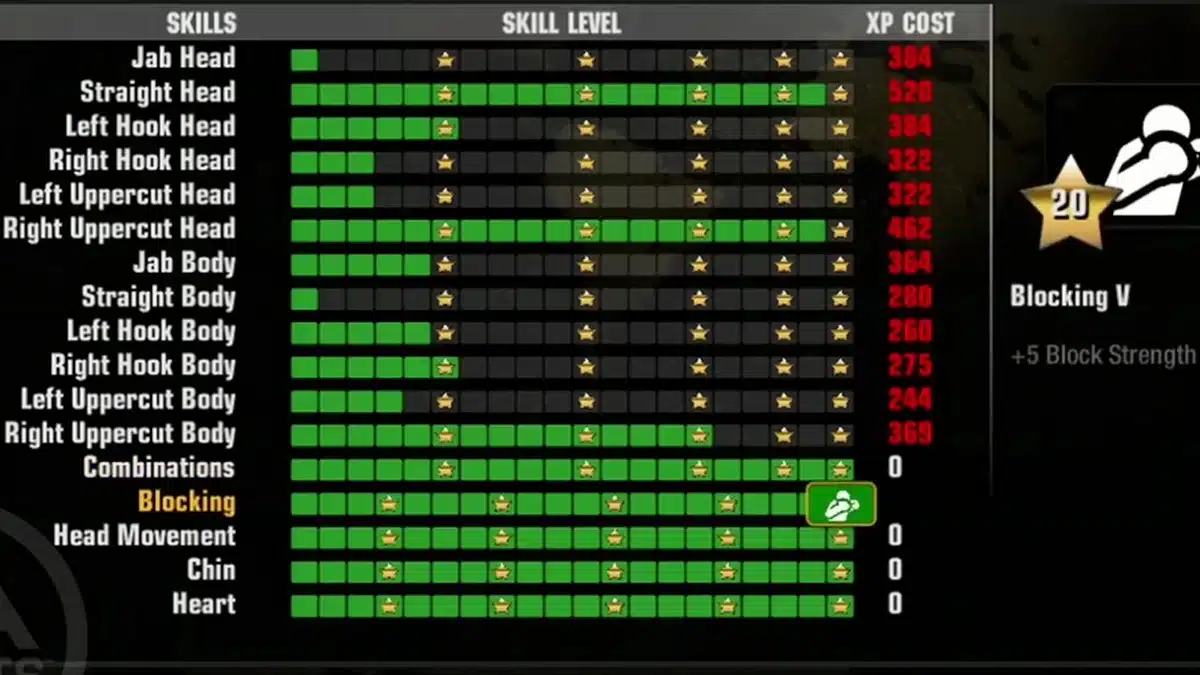
This is the core Skill allocation I recommend for a southpaw version of the build:
| Attribute | Recommended Skill Level |
|---|---|
| Straight to Head | 20 |
| Right Hook to Head | 15 |
| Left Uppercut to Head | 15 |
| Jab to Body | 15 |
| Straight to Body | 15 |
| Right Hook to Body | 15 |
| Combination Punching | 19 |
| Blocking | 20 |
| Head Movement | 16 |
| Chin | 20 |
| Heart | 16 |
This is a core allocation rather than a complete 220-Level blueprint. The remaining Skill Levels give you room to strengthen additional punches according to your own style.
How Stance Changes the Punch Allocation
Orthodox and southpaw boxers should not use identical side-specific punch allocations.
The Jab and Straight retain their in-game roles, but the side-specific hooks and uppercuts should be mirrored when changing stance.
For example, this southpaw setup invests in:
- Right Hook to Head
- Left Uppercut to Head
- Right Hook to Body
For an orthodox boxer, reverse those side-specific investments:
- Left Hook to Head
- Right Uppercut to Head
- Left Hook to Body
This keeps the build centred around the punches that work most naturally from the chosen stance instead of blindly copying the same left and right Skill Levels onto every boxer.
Why These Skill Levels Work
Straight to Head: 20
The Straight is one of the most effective offensive punches in Fight Night Champion and deserves the maximum Skill Level in this build.
Level 20 maximises the punch as one of your primary head attacks and gives the boxer strong knockout potential.
The Straight should not be confused with a defensive stat. Its role here is to cause damage and create knockout opportunities.
Chin: 20
Chin is the main defensive investment against head damage.
Combined with maximum body weight, a Level 20 Chin gives this build as much protection as possible against opponents looking for stuns, knockdowns and flash knockouts.
Blocking: 20
Blocking is particularly important at Heavyweight, where individual power punches can cause significant damage.
I recommend Level 20 for the full defensive setup.
At lighter weights, experienced players can reduce Blocking towards 15 if those Skill Levels are more valuable elsewhere, but doing so gives you less margin for defensive mistakes.
Combination Punching: 19
This build stops Combination Punching at 19 rather than spending another Skill Level to reach 20.
The saved level can be redirected into a punch that contributes more directly to your own attacking style.
Head Movement: 16
Level 16 provides a strong base for head movement without consuming Skill Levels that this build needs for its main punches and defensive attributes.
Players who rely heavily on slipping and counter-punching can increase it further using some of their remaining allocation.
Heart: 16
Heart protects against body damage and body stuns.
Level 16 provides a useful balance for this setup without investing the same 20 Levels used for Chin.
Jab and Straight to Body: 15
The Jab and Straight to the body give the boxer reliable tools for interrupting opponents, attacking stamina and preventing players from concentrating exclusively on defending their head.
They support the build rather than acting as its main knockout punches.
Hook and Uppercut Skills: 15
The selected hook and uppercut investments provide stronger close-range options when an opponent gets inside or begins anticipating the Straight.
Which side receives those levels depends on whether the boxer uses southpaw or orthodox stance.
How to Spend the Remaining Skill Levels
The table intentionally leaves part of the 220 Skill Level cap available.
Do not spread those remaining levels randomly across every unused punch.
Instead, strengthen the attacks you actually land.
Good candidates include:
- your preferred head uppercut
- your preferred head hook
- an additional body hook
- Head Movement if slipping is central to your defence
- Heart if you regularly struggle against body-focused opponents
The correct final allocation depends on how you fight.
If most of your knockdowns come from the Straight and one particular uppercut, strengthening those punches is more valuable than adding Skill Levels to attacks you rarely throw.
The same principle applies defensively. A player who relies heavily on blocking may value Level 20 Blocking more than someone with exceptional movement and distance control.
Your boxer setup creates the tools, but how effectively you use them still depends on your Fight Night Champion tactics, including counter-punching, stamina management, defence and ring positioning.
The aim is not to create a boxer with impressive numbers across every category. It is to concentrate the limited Skill Levels into attributes that directly support the way you fight.
Tip: If you’re playing as an orthodox fighter, reverse the side-specific punches. For example, what is the right hook to the body for a southpaw becomes the left hook to the body for an orthodox fighter.
These builds have been tested at all weight classes and prioritises punch efficiency, defensive resilience, and control – everything you need to win more and have fun doing it.
Make sure to visit our comprehensive Fight Night Champion Guide, your ultimate resource hub filled with tutorials, tips, and strategies tailored for players on PlayStation, Xbox, and backwards-compatible platforms.