
Key Highlights:
- Tomb Raider: Legacy of Atlantis introduces a Focus system that builds through combat and slows time for Lara’s acrobatic attacks.
- Lara has four weapon types, although the entire game can still be completed using her infinite-ammo dual pistols.
- Crystal Dynamics and Flying Wild Hog have revealed skill-tree progression and crafting for the first time.
Crystal Dynamics and Flying Wild Hog have revealed how combat and progression work in Tomb Raider: Legacy of Atlantis, including four weapon types, a new Focus system, skill trees and crafting.
The details come from Combat & Progression Reimagined, the sixth developer diary examining the upcoming reimagining of Lara Croft’s original 1996 adventure. The episode focuses on how the developers are expanding combat while preserving the acrobatic movement associated with classic Tomb Raider.
Focus is the biggest new combat system. Lara builds the meter by dealing damage, taking damage and dodging enemy attacks. Activating it slows the action around her and creates an opportunity to perform acrobatic manoeuvres while continuing to fire.
Game director Raul Siqueira said the mechanic was created because Lara’s acrobatics remain an important part of her character. The developers wanted those movements to remain practical during combat rather than leaving Lara vulnerable whenever she performs them.

Lara’s arsenal consists of four weapon types: her dual pistols, a shotgun, an SMG and an assault rifle. Each is designed around a different combat range and approach rather than functioning as a straightforward damage upgrade.
The dual pistols retain infinite ammunition. More unusually, Crystal Dynamics says players can complete the entire game without abandoning them, although relying exclusively on Lara’s signature weapons will make combat more difficult.
I think that dual-pistols-only route is the most revealing design choice in the new footage because it lets players retain a recognisably classic Tomb Raider combat style even while Legacy of Atlantis layers modern weapon and progression systems around it.
Enemy behaviour is also intended to reward observation. Lead enemy designer Lukasz Taborski says players will gradually learn attack patterns and anticipate how different threats behave, with examples including panthers and velociraptors.
The combat approach was already partially visible during June’s Summer Game Fest demo. Velociraptors forced Lara to remain mobile while firing her dual pistols, with dives, rolls and cartwheels used to avoid incoming attacks. Focus could then be spent to trigger an acrobatic flip while briefly slowing time.
Legacy of Atlantis is also introducing a skill-tree progression system.
Artifacts contribute to Lara’s progression by providing Skill Points that can be spent on new abilities. The developer diary shows separate progression associated with combat and survivability, bringing a more structured upgrade layer into the reimagined 1996 adventure.
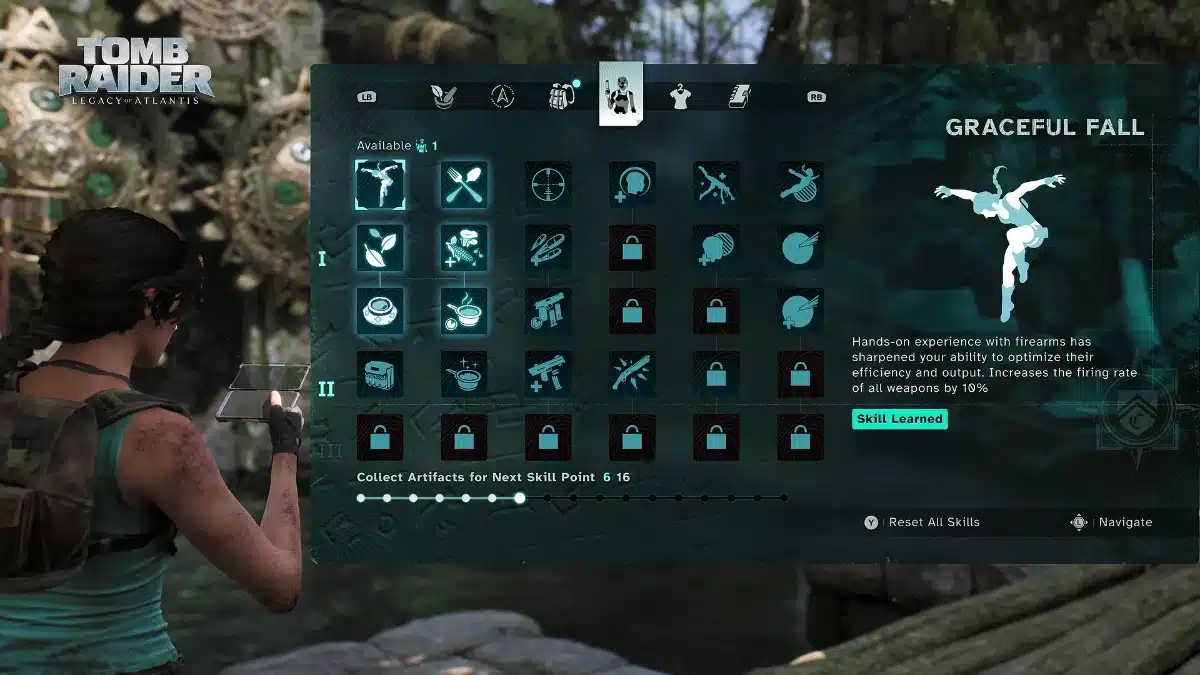
Crafting accompanies those upgrades. Lara can gather herbs and other resources from the environment, with combinations used to create healing items and passive effects such as reduced incoming damage. Bandages can also be crafted for recovery during dangerous encounters.
Those systems have clear roots in the modern Tomb Raider games. Crystal Dynamics’ own description of the Survivor trilogy identifies resource gathering, crafting and skill upgrades as defining parts of that era, while Legacy of Atlantis is applying similar progression concepts to a Lara who is already an experienced adventurer.
The developers have previously said that distinction influences the combat design. During Summer Game Fest, Siqueira explained that the team examined what worked for Lara during the Survivor era before deciding what still made sense for the more capable version of the character depicted in Legacy of Atlantis.
Earlier this year, I was still waiting to see how combat would fit alongside Legacy of Atlantis’ traversal and environmental puzzles. The latest developer diary now gives that part of the remake a much clearer shape, with Focus, four weapon types, crafting and skill progression sitting alongside the exploration-heavy structure.
Crystal Dynamics has repeatedly described Legacy of Atlantis around the balance between exploration, puzzles, traversal and fighting, while the reworked Lost Valley demonstrated at Summer Game Fest initially contained no combat at all.
That area instead emphasised environmental navigation, optional paths, collectibles and hidden resources. The original Tomb Raider’s more isolated rooms have also been expanded into semi-connected environments that can be approached from different directions.
Players will be able to tune those different parts of the experience separately. Crystal Dynamics has confirmed independent difficulty settings for combat and puzzles, allowing one aspect to be made easier or harder without applying the same setting across the whole adventure.
Legacy of Atlantis is a complete reimagining of the 1996 Tomb Raider rather than a direct remaster. Lara again travels through Peru, Greece, Egypt and a mysterious Mediterranean island while searching for the scattered pieces of the Scion, but environments, puzzles and gameplay systems have been substantially rebuilt in Unreal Engine 5.
Legacy of Atlantis was first revealed as a modern reimagining of Lara Croft’s 1996 debut, rebuilding the Scion adventure with Unreal Engine 5 while preserving the original game’s core structure.
Tomb Raider: Legacy of Atlantis releases on 12 February 2027 for Nintendo Switch 2, PlayStation 5, Xbox Series X|S and PC.