
Key Highlights:
- Hogwarts Legacy receives NVIDIA DLSS 5 on November 5, introducing AI-enhanced lighting, materials and environmental detail.
- Avalanche Software has adjusted the technology to preserve character appearances following criticism of earlier DLSS 5 demonstrations.
- The update supports GeForce RTX 50 Series hardware, RTX Spark PCs and GeForce NOW Ultimate, with Nvidia claiming up to 300 FPS at 4K on an RTX 5090 under specific settings.
Quick Links:
Hogwarts Legacy DLSS 5 support arrives November 5, 2026, bringing Nvidia’s 3D-Guided Neural Rendering technology to the PC version of the open-world RPG.
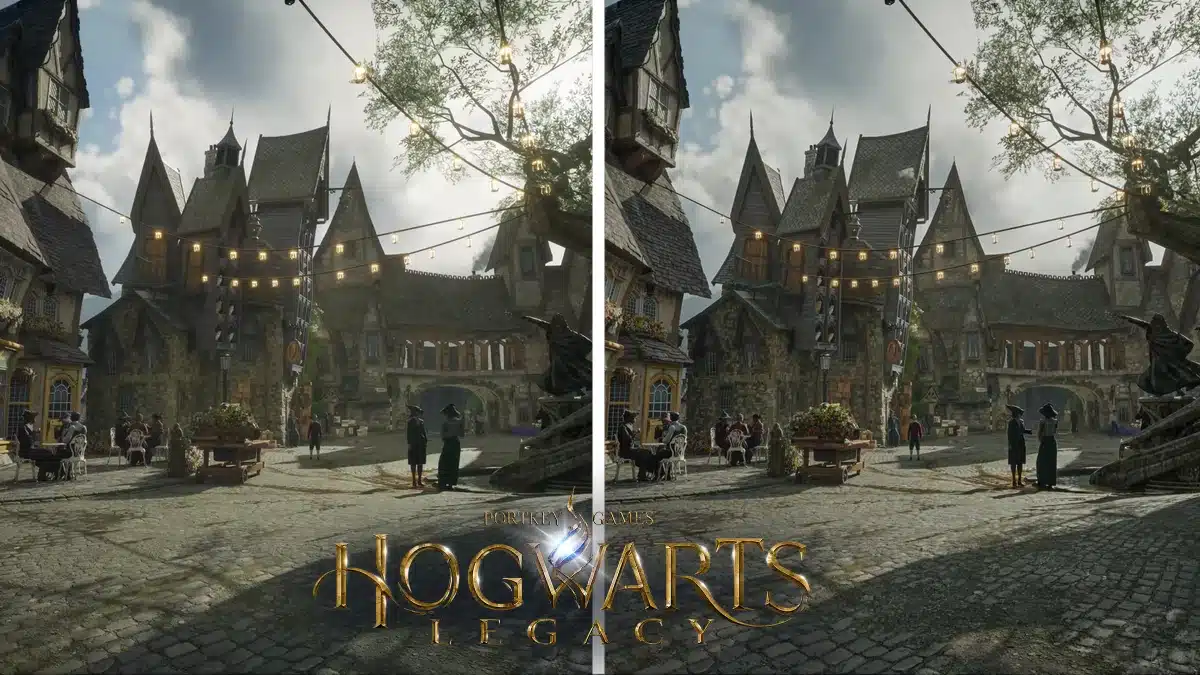
Nvidia has released a new gameplay demonstration showing improved lighting, environmental textures, shadows and reflections. Unlike earlier DLSS 5 footage, the updated implementation places greater emphasis on preserving the game’s existing character designs.

According to Nvidia’s November 3 announcement, the technology uses artificial intelligence to enhance rendered scenes while retaining the underlying geometry and artistic elements created by the developers.
In Hogwarts Legacy, the changes are particularly noticeable around Hogsmeade. Stone walls gain more detailed shading, foliage receives stronger contact shadows, and weathered rooftops display additional material depth.
The improvements extend to character clothing, skin and reflections, although Avalanche Software has deliberately adjusted how the technology affects faces.
Earlier DLSS 5 demonstrations attracted criticism for producing exaggerated facial details and altering character appearances. The latest implementation uses developer-controlled settings to reduce those effects.
Jose Villeta, Director of Software Engineering at Avalanche Software, confirmed that the studio worked closely with Nvidia to refine the technology. The team adjusted environments, lighting tone and skin-related parameters to maintain the game’s established visual style.
This is possible because DLSS 5 gives developers control over the strength and application of its neural rendering effects. Different settings can be applied to individual scenes, objects or characters rather than forcing the same enhancement across the entire game.
I would pay more attention to those controlled changes than the pursuit of photorealism alone. Improving the depth of Hogsmeade’s buildings without substantially changing the people inhabiting them is a more convincing demonstration of what this technology can offer.
How to Enable DLSS 5 in Hogwarts Legacy
Players with supported hardware can activate the new technology after installing the November 5 update.
Nvidia confirms that DLSS 5 is supported on GeForce RTX 50 Series desktop GPUs and laptops, RTX Spark PCs and GeForce NOW Ultimate.
Once the update is installed, players can open the game’s graphics settings and enable Neural Rendering.
For its recommended configuration, Nvidia also suggests enabling DLSS Super Resolution, Multi Frame Generation, Nvidia Reflex and DLSS Ray Reconstruction when using ray-traced effects.
The company claims that an RTX 5090 can run Hogwarts Legacy at up to 300 FPS at 4K, with maximum settings, ray tracing, DLSS 5, Ray Reconstruction and 6X Multi Frame Generation enabled.
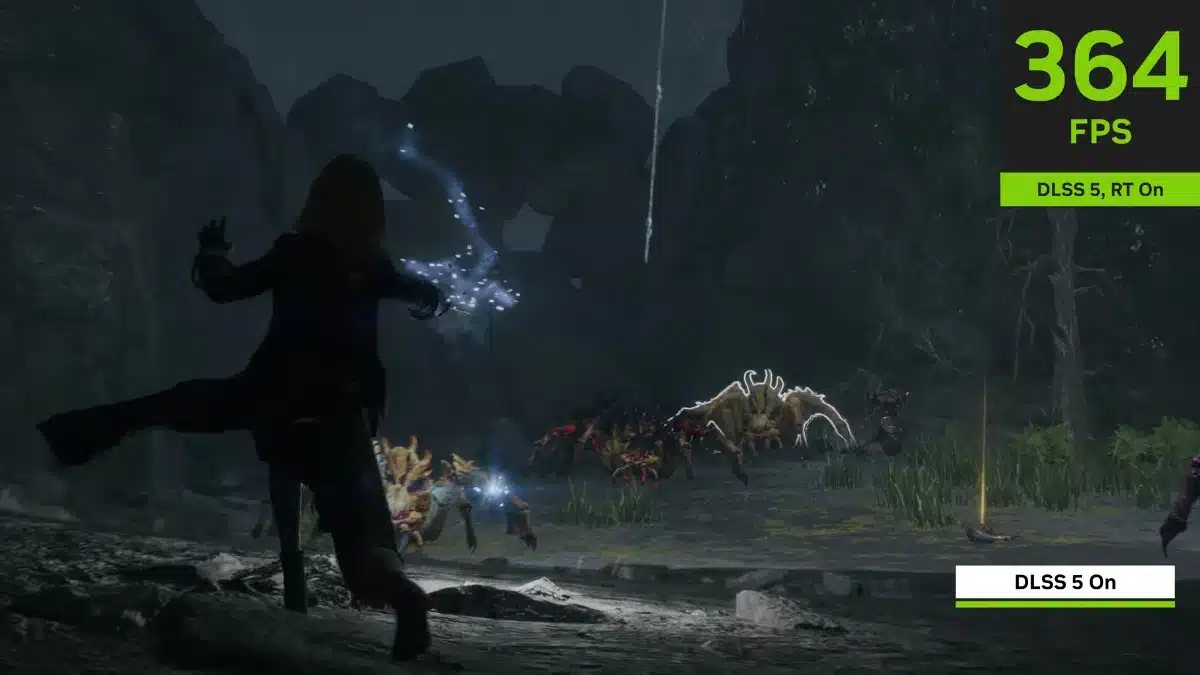
However, that figure includes AI-generated frames. It should not be interpreted as 300 traditionally rendered frames per second, and Nvidia has not established that every RTX 50 Series GPU will achieve comparable performance.
There is also a technical distinction between the new feature and existing DLSS options. DLSS Ray Reconstruction, recently added to Silent Hill: Townfall, improves the reconstruction of ray-traced effects. DLSS 5’s Neural Rendering goes further by generating additional lighting and material detail.
Nvidia has also improved the underlying model ahead of the Hogwarts Legacy release. The October 2026 version is approximately 24% smaller, uses 20% less VRAM at 4K and performs twice as fast as the previous model, according to the company.
The model now contains approximately 118 million parameters, helping bring DLSS 5 to a wider selection of supported RTX 50 Series devices.
Nvidia’s new GeForce Game Ready Driver 621.14, released November 4, includes optimisations for the upcoming update and can be installed through the Nvidia app or the company’s driver website.
The latest upgrade continues the game’s PC development following earlier changes to Hogwarts Legacy’s modding tools and stability.
Beyond Hogwarts Legacy, Nvidia has confirmed that DLSS 5 will arrive in War Thunder during mid-November, followed by Where Winds Meet on November 23.
The November 5 update is specifically a PC graphics enhancement. No equivalent DLSS 5 support has been announced for the PlayStation, Xbox or Nintendo Switch versions of Hogwarts Legacy.