Disney’s Planes is clearly aimed at younger players, but that doesn’t mean there is nothing interesting underneath its simple flight mechanics.
Developed by Behaviour Interactive for Wii U and based on Disney’s 2013 animated film, the game takes Dusty Crophopper and other familiar characters around a series of locations inspired by the movie. Story missions provide the main progression, while racing, exploration and other activities give players reasons to return to areas they have already visited.
The controls are deliberately accessible. Within a short time I could turn, accelerate and perform aerial manoeuvres without having to learn anything approaching a flight simulator.
That simplicity makes Planes easy to pick up, particularly for children.
What surprised me more was the amount of freedom it occasionally provides. Some of my favourite moments came when the game stopped pointing directly towards an objective and allowed me to work out where I wanted to go.
Quick Links:
Story Mode Keeps Its Missions Short
Story mode provides the main introduction to the game.
The narrative is simple and clearly designed with younger players in mind. Missions send the characters around different locations completing jobs, helping other planes and taking part in events rather than attempting to tell a particularly complex story.
Completing missions awards medals based on performance, while progression unlocks additional content and activities.
I found levelling up very easy, but what I liked most was that the levels were short enough that I didn’t mind going back and replaying them.
That is important for the audience.
A mission that lasts too long can make repeating it for a better result tedious. Planes generally keeps objectives compact enough that replaying one doesn’t feel like a major commitment.
The structure also works well on Wii U because it is easy to play a couple of missions without needing a long session.
Exploration Gives Flying Some Freedom
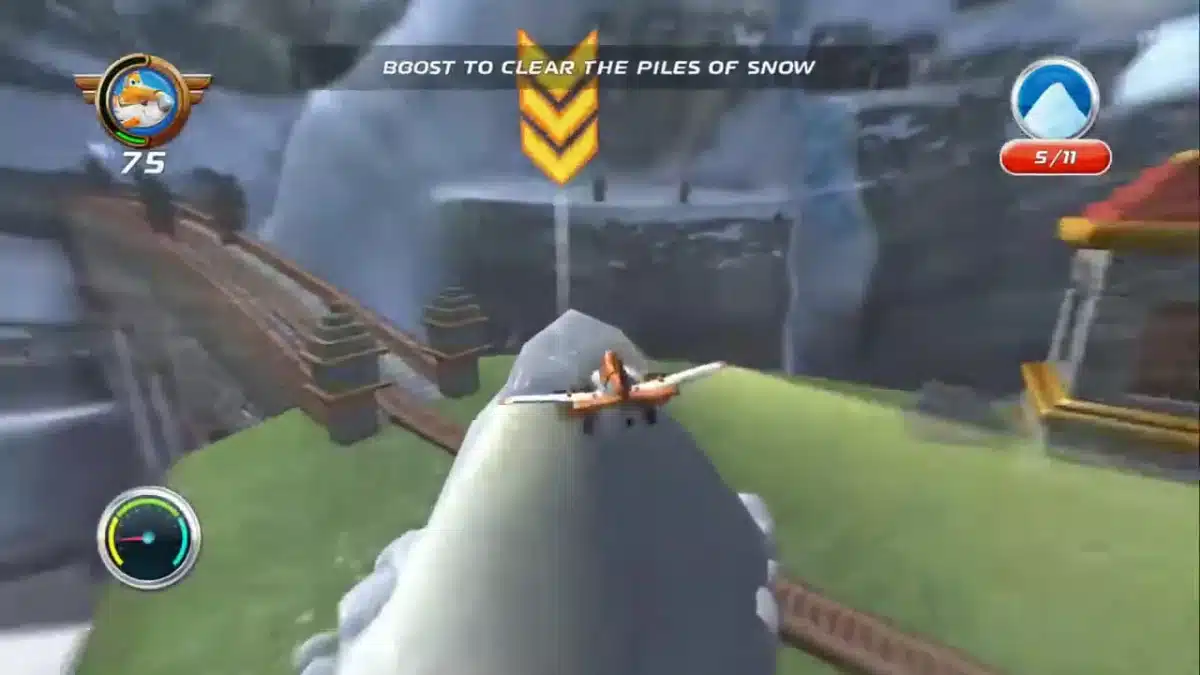
What I particularly liked was the sense of freedom.
I enjoyed being able to leave the obvious path and explore for hidden areas and experience points. The maps aren’t enormous, but having reasons to fly away from the direct route makes controlling a plane considerably more enjoyable.
That freedom also carries into locations I had already visited.
I found it enjoyable to race around familiar areas, tend to crops in the hometown area and complete the different objectives scattered across the game.
The downside is scale.
The maps were still pretty small, which was one of the bigger weaknesses for me. Flying naturally creates an expectation of distance and open space, so boundaries become much more noticeable when you can cross an area quickly.
A larger world could have made exploration significantly more rewarding.
Even so, I appreciated that Planes occasionally trusted me to fly somewhere simply because I wanted to see what was there.
Navigation Is Better When the Arrow Disappears
Some mission objectives are more interesting than simply following a waypoint.
I particularly liked having to use the lights on the plane to work out where to go. I thought that was a cool mechanic and wished it had been used much more frequently.
It made navigation part of flying rather than reducing every journey to chasing an arrow around the screen.
I would actually have preferred those lights to remain part of the navigation system throughout the game instead of relying so heavily on an obvious directional marker.
There were occasions when the arrow wouldn’t appear until I reached the relevant area. I liked that because navigating felt slightly more natural to me.
It’s a small mechanic, but it demonstrates something the game could have explored much further.
For younger players, following an arrow is obviously accessible. But using visual information from the aircraft itself encourages the player to look at the world and understand where they are going.
More missions built around that idea would have given Planes considerably more depth without making the controls complicated.
The Controls Reminded Me of Star Fox 64
The flight model is designed around accessibility rather than realism.
Planes can turn sharply and perform aerial manoeuvres without demanding complicated inputs. The controls reminded me of Star Fox 64, particularly with the ability to perform U-turns, flips and barrel rolls.
That arcade-style approach suits the game.
Dusty isn’t supposed to handle like an aircraft in a serious flight simulator. Movement needs to be immediate enough for children to understand while still giving them something entertaining to do in the air.
The manoeuvres help.
Performing a barrel roll or quickly changing direction makes basic movement more playful, while races give those controls a clearer purpose.
The simplicity eventually limits the challenge. Experienced players are unlikely to struggle for long, and the easy progression means there isn’t much mechanical resistance.
But I don’t think difficulty is the right standard by which to judge everything here.
For its intended younger audience, being able to pick up the GamePad and immediately understand how to fly is a genuine strength.
Different Activities Add Variety
Planes does more than send the player through a sequence of conventional races.
Story objectives, free-flight exploration and other activities break up the campaign, while revisiting locations gives players additional things to complete.
That variety matters because the underlying flight mechanics are simple.
Racing provides the most obvious competitive use for the controls, while exploration encourages a slower approach. Other objectives give the characters jobs that fit the film’s world rather than making every mission another race to a finish line.
Not every activity has much depth, and repetition eventually becomes noticeable.
Still, the game benefits from changing what it asks the player to do.
For younger players in particular, that makes the experience feel broader than a straightforward collection of flying races.
Wii U Co-op Is One of the Best Features
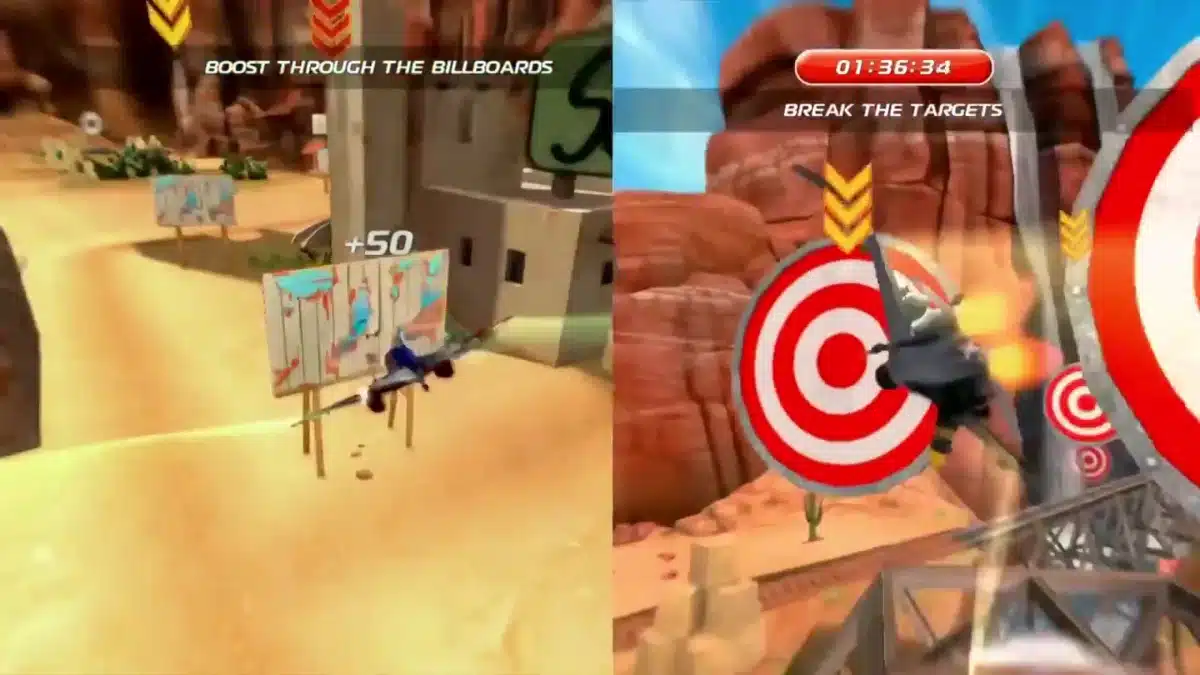
The Wii U version has one particularly useful advantage: its local two-player setup.
One player can use the Wii U GamePad and its integrated screen while the second player uses the television with a Wii Remote and Nunchuk.
That means both players have their own display rather than sharing the television through split-screen.
I liked the drop-in multiplayer, and I think this is where Planes makes the most sense as a family game.
A child can play alongside a parent without the second player needing to learn complicated controls. The simplicity that limits the single-player challenge becomes much more useful when two people with very different levels of gaming experience are playing together.
The Wii U hardware suits that arrangement particularly well.
It’s not sophisticated multiplayer, but it understands the likely audience.
Visuals Barely Push the Wii U
The visuals are much less impressive.
Characters are recognisable and the bright presentation fits the Disney film, but environments are sparsely detailed and rarely demonstrate what the Wii U hardware could achieve.
That was disappointing to me even in 2013.
The relatively small maps should theoretically have allowed more environmental detail, but many locations still feel basic.
Contemporary testing also described the game as generally smooth while noting occasional slowdown during busier racing sequences. That is an external observation rather than a historical GLN frame-rate measurement.
I do not have sufficiently reliable evidence for the Wii U version’s exact internal rendering resolution or frame-rate target, so I would rather leave both unspecified than infer them from the console’s HD output.
The Wii U edition distinguishes itself primarily through Nintendo’s controller hardware rather than substantially improved graphics. Its GamePad allows each player to have a separate screen during local multiplayer, while Off-TV Play also lets the game run without using the television:
| Wii U Feature | Disney’s Planes |
|---|---|
| Platform | Wii U |
| Wii U GamePad | Supported |
| Off-TV Play | Supported |
| Wii Remote + Nunchuk | Supported for second player |
| Local multiplayer | Two players |
| Multiplayer display | GamePad + television |
| Split-screen required | No |
| Internal rendering resolution | Not reliably established |
| Frame-rate target | Not reliably established |
| Physical release | Yes |
| Historical digital distribution | Nintendo eShop |
The Wii U eShop has since closed for new purchases, so the original digital version can no longer be bought directly through Nintendo. Physical Wii U copies remain the conventional way to obtain this specific version.
A Family Game That Understands Its Audience
Disney’s Planes isn’t particularly difficult, technically ambitious or mechanically deep.
For an experienced player, the small maps and simple progression are obvious limitations. I wanted larger environments, more reasons to explore and much more use of the navigation ideas that briefly made me think about where I was flying.
But I also enjoyed it more when I judged those systems in the context of who the game was made for.
The controls are immediately understandable. Missions are short enough to replay without becoming a chore. Different activities provide some variety, and the Wii U’s two-screen multiplayer makes playing alongside a younger family member much more practical than conventional split-screen.
There are also glimpses of a more interesting flight game underneath the simplicity.
Leaving the expected route to search for experience points gave me a welcome sense of freedom. Using the aircraft’s lights for navigation was a clever idea, and I enjoyed the occasions when the game delayed its directional arrow and allowed me to find my own way.
Those mechanics made flying feel more involved without making it inaccessible.
I just wish Behaviour Interactive had trusted them more often.
Planes is therefore difficult to recommend to anyone looking for a challenging arcade flight game. Its environments are too small and its mechanics too straightforward for that.
For younger Disney fans, however, the same simplicity becomes one of its strengths.
It is approachable, easy to replay and particularly well suited to a child and parent playing together on Wii U. It may not push Nintendo’s console very hard, but it understands its audience better than many movie tie-ins.
Disney’s Planes Quick Facts
Developer
Behaviour Interactive
Publisher
Disney Interactive Studios
Reviewed platform
Wii U
European Release Date
16 August 2013
Genre
Arcade flight / racing
Game Modes
Single-player, local multiplayer
Local players
Two
Wii U GamePad
Supported
Off-TV Play
Supported
Second-player controller
Wii Remote + Nunchuk
Performance
Yes
Disney’s Planes
Our Disney’s Planes Wii U review looks at its easy flight controls, two-player co-op and exploration, plus why its small scale limits the experience.
Product Brand: Disney
6
Pros
- Accessible flight controls make it easy for younger players.
- Short missions work well for replaying and quick sessions.
- Exploration adds a little freedom to the simple structure.
- Local two-player Wii U co-op is ideal for family play.
- The game understands its intended audience well.
Cons
- Small maps limit the sense of scale and freedom.
- Visuals are basic and don’t show off Wii U hardware.
- Repetition becomes noticeable over time.
- Difficulty is too light for experienced players.
- Navigation ideas are underused.