
Key Highlights:
- Gran Turismo 7 Update 1.71 adds four cars, three World Circuit events and a new Whistler Scapes collection.
- Polyphony Digital has also reworked tyre behaviour, suspension, steering, traction control, ABS and Performance Points.
- The update resets multiple leaderboards, introduces 10 engine swaps and adds a new Seasonal Menu.
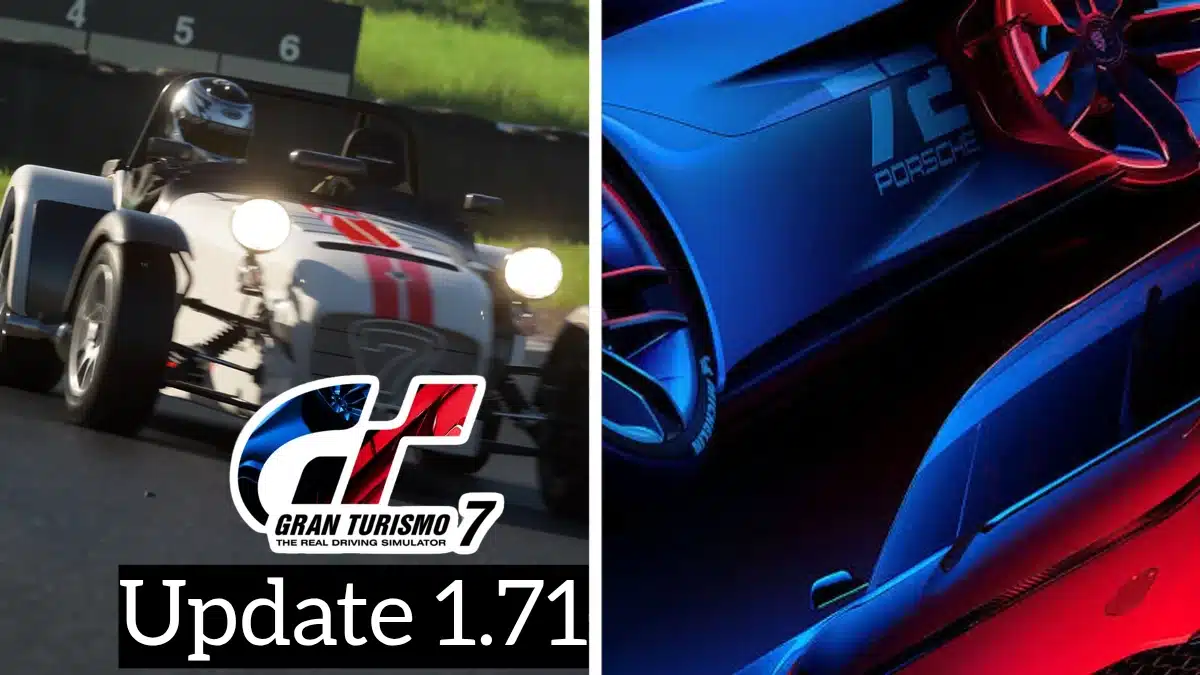
Polyphony Digital has released Update 1.71 for Gran Turismo 7, adding four new cars while making substantial changes to the game’s underlying driving physics.
The four additions are the Caterham Seven Superlight R500 ’08, Hyundai IONIQ 6 N ’25, Toyota Chaser Tourer V ’97 and Toyota Mark II Tourer V ’97. The Caterham and Hyundai are sold through Brand Central, while both Toyota models appear in the Used Cars dealership.

The Caterham is perhaps the most unusual addition. The 2008 Superlight R500 produces 263 bhp and carries a power-to-weight ratio of 520 bhp per tonne. Caterham says the car later recorded a 1:17.9 lap around Top Gear’s Dunsfold test track, beating the Bugatti Veyron.
Hyundai’s IONIQ 6 N represents the opposite end of the engineering spectrum. The electric saloon produces up to 650 PS from its 84 kWh four-wheel-drive powertrain, bringing another modern Hyundai N model into GT7.
The two 1997 Toyotas share the same enthusiast appeal. Both the Chaser Tourer V and Mark II Tourer V use Toyota’s turbocharged 2.5-litre 1JZ-GTE engine, making them natural additions for players interested in late-1990s Japanese tuning culture. Toyota’s own period material identifies the 1JZ-GTE as the performance engine used in Tourer V models.
Update 1.71 also adds three World Circuit events:
| Event | Circuit |
|---|---|
| Japanese FR Challenge 450 | Kyoto Driving Park – Yamagiwa |
| European Clubman Cup 600 | Circuit de Barcelona-Catalunya GP Layout No Chicane |
| World Touring Car 600 | Suzuka Circuit |
Whistler also joins Scapes as a featured Curation.
The bigger change sits underneath those headline additions.
Polyphony Digital has adjusted GT7’s tyre physics algorithm, with particular attention paid to what happens when tyres begin to slip. Tyre heating, wear, rolling resistance and off-track grip loss have all been revised.
Suspension and steering behaviour have also changed. Polyphony has adjusted steering geometry, damper attenuation and the way cars respond to changes in stance and road surface contact. Engine torque control has also been modified to improve partial-throttle behaviour and drifting response.
Traction Control and ABS receive their own revisions, while controller users get altered steering, throttle and brake response. Steering-wheel players also receive changes to force-feedback strength, friction and understeer vibration.
I think the physics overhaul is considerably more important than the four-car headline because it changes how the existing GT7 garage behaves, not just what players can add to it.
Performance Points have been recalculated across the game, while base suspension, differential and aerodynamic settings have been changed for a wide range of cars. That means previously tuned vehicles may no longer sit at the same PP level after the update.
The physics changes are significant enough that Polyphony Digital has reset ranking boards across Circuit Experience, Licence tests, Missions and Music Rally. Target times have also been adjusted to reflect the new driving behaviour.
Mechanical damage receives another revision. A new Championship damage option causes cars to take damage from smaller impacts than the Light setting, while recovery time now varies depending on how serious the damage is.
Shortcut penalties have also been toned down.
Update 1.71 expands the tuning side of GT7 with 10 new engine swaps. Three of the four newly added petrol-powered cars receive swaps immediately rather than waiting for a future update.
The Caterham Seven can swap its 263 bhp engine for the Suzuki Jimny’s 658cc R06A unit. That sounds backwards on paper, but Caterham has sold entry-level Seven variants using Suzuki’s small turbocharged engine in the real world.
The Toyota Chaser and Mark II both gain access to a 4.48-litre Lexus-derived 3UZ-FE engine producing 516 bhp in GT7. Each swap costs 500,000 credits.
Other new combinations include a 1,079 bhp Windsor V8 for the Ford Focus RS and Mitsubishi Lancer Evolution IX, a GT3-spec AMG engine for the Mercedes-Benz 300 SEL 6.8 AMG, and a Honda Super GT engine for the Red Bull X2014 Junior.
A new Seasonal Menu is also being added to the Café. It becomes available after completing Menu Book No. 39 and watching the ending, giving players another rotating car-collection route with additional rewards.
The August update also adds a Circuit Experience for the Barcelona-Catalunya Rallycross layout and new Café conversations tied to the Caterham, IONIQ 6 N, Chaser and Mark II.
PS5 Pro users receive an updated version of PlayStation Spectral Super Resolution when PSSR is enabled. Fanatec GT DD Pro users also gain FullForce feedback support, although Polyphony notes that a planned firmware update is required to use the feature.
The update follows Gran Turismo 7’s much larger Spec III expansion from December 2025, which introduced the Power Pack DLC, GT Sophy 3.0, two new circuits and major telemetry tools.