

Mahokenshi combines deck-building with turn-based tactical exploration across the Celestial Islands, where every card, route and enemy encounter can influence how a mission unfolds.
Developed by Game Source Studio and published by Iceberg Interactive, the PC game uses handcrafted hex-based maps rather than procedurally generated levels. Each mission begins with a basic deck that can be developed as you explore, while terrain, enemies and points of interest create tactical decisions beyond simply choosing which card to play next.
After around ten and a half hours with Mahokenshi, I was already more than halfway through the game. More importantly, I was having an absolute blast with it. For me, it was one of the best deck-building games I’d played in a long time.
Quick Links:
Every Mission Gives You Something Different to Solve
One of Mahokenshi’s greatest strengths is its mission design. The missions I played felt genuinely different from one another rather than variations of the same objective.
Some scenarios also place pressure on you through limited turns or objectives that need to be completed within a particular timeframe. I normally dislike timed objectives because I prefer relaxing and progressing at my own pace, but they worked surprisingly well here.
Instead of making me feel rushed, the restrictions forced me to make meaningful decisions about where I travelled and what I prioritised. I found that pressure exciting rather than frustrating.
Failure did not necessarily mean I had wasted my time either. If I reached an encounter I couldn’t overcome, I could return to previous missions, earn experience and unlock additional upgrades before trying again.
I eventually hit a wall against one particular encounter and did exactly that. I’d already used the same approach a couple of times, and returning stronger to finally overcome something that had previously stopped me was extremely satisfying.
Handcrafted Maps Make Exploration Part of the Strategy
The maps were fantastic and became one of my favourite parts of Mahokenshi.
Rather than giving me a single obvious route towards an objective, they encouraged me to consider what I wanted to accomplish along the way. Shrines, temples, new cards, energy upgrades, trinkets, healing opportunities and other useful locations could all influence the route I chose.
Terrain makes those decisions more important. Mountains, hills and forests can affect movement or combat, while cards and abilities can help mitigate certain disadvantages. Steam’s description similarly identifies terrain as a tactical consideration rather than purely visual scenery.
I therefore found myself planning several moves ahead. Taking the shortest route towards an objective was not always the best option if a small detour could improve my deck or put me in a stronger position for the encounters ahead.
Deck management became part of that planning. Whenever an opportunity appeared, I wanted to remove weaker basic cards as quickly as possible rather than allowing them to dilute the stronger combinations I was building during the mission.
Enemy spawners added another consideration on some maps. Deciding when it was worth diverting from my immediate objective to destroy one could affect how manageable the rest of the mission became.
There was simply a lot to think about on every map, and I rarely felt as though the game was pushing me towards one correct solution.
Combat Rewards Positioning as Much as Good Cards
Combat is turn-based, but the cards in your hand are only one part of the tactical system.
Different enemies forced me to reconsider how and where I fought. Some opponents would retreat and potentially draw me towards other enemies, while ranged attackers could remain several tiles away and continue attacking from a safer position.
Against tougher enemies and bosses, choosing the location of a fight became particularly important. Whenever possible, I liked positioning myself near somewhere I could restore health before committing to a dangerous encounter.
Terrain could also provide an advantage. Hills could improve my offensive potential, while forests could provide additional defence, giving positioning an immediate effect on combat rather than simply determining whether an enemy was within range.
Some opponents could hit incredibly hard. One particularly memorable enemy had 30 defence and regenerated all 30 points after every turn. I had to break through that defence before I could even begin damaging its health, making the encounter brutal if I couldn’t produce enough damage quickly.
Encounters like this were where Mahokenshi’s deck-building and tactical positioning worked particularly well together.
Sota’s Poison and Stealth Became My Favourite Playstyle
There are four playable Mahokenshi, with each belonging to a different house and supporting a distinct style of play. The game contains more than 200 cards, giving those characters room to develop different combinations as missions progress.
My personal favourite was Sota, whose poison, mobility and stealth abilities suited the way I wanted to approach encounters.
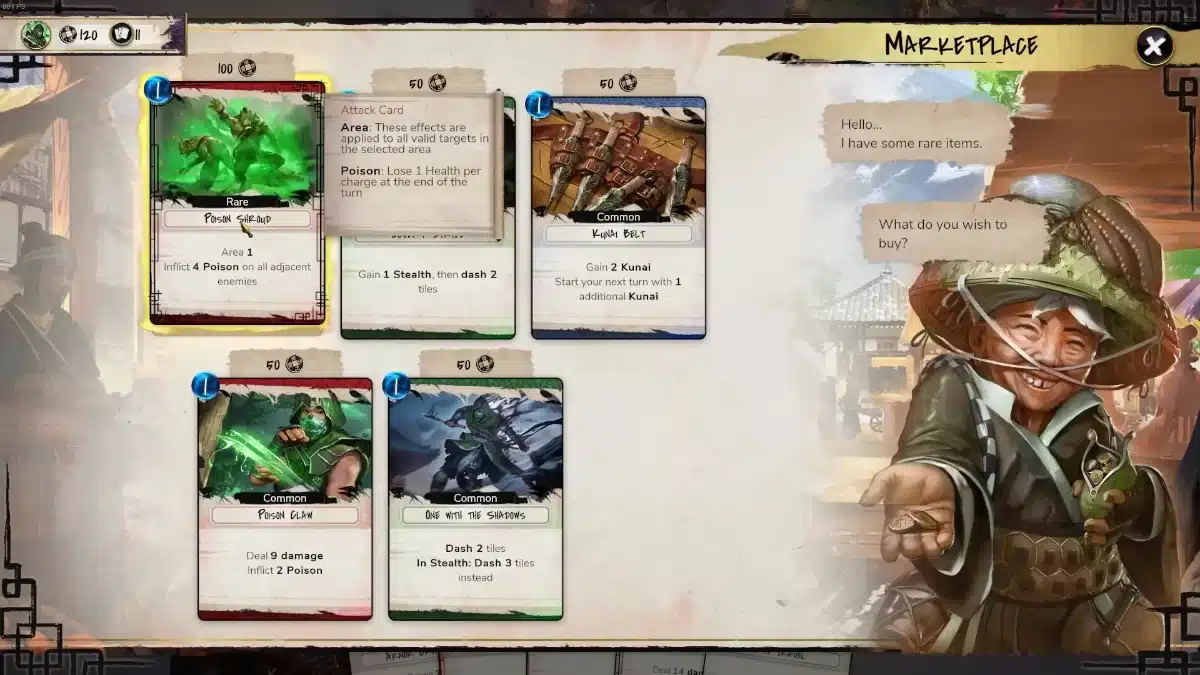
Against powerful enemies, I could inflict poison and then use Sota’s mobility to create distance while the status effect continued dealing damage. I found this particularly effective against dangerous individual opponents and larger groups because it allowed me to kite enemies around the map rather than meeting everything head-on.
Stealth opened another possibility. I enjoyed combining Sota’s stealth abilities with cards that increased the damage of attacks performed from stealth, creating another reason to think about positioning and the order in which I played my cards.
This character-specific design gives Mahokenshi considerably more depth than simply offering four interchangeable heroes. Sota specialises in poison and mobility, while the other Mahokenshi support substantially different approaches involving offence, defence, summoning and area-of-effect abilities.
The Difficulty Could Have Been More Demanding

For all the tactical decisions Mahokenshi asks you to make, I found the overall difficulty surprisingly forgiving.
After roughly nine hours and reaching around the halfway point, I’d only really died once. Individual enemies and encounters could certainly be dangerous, but the game as a whole rarely pushed me as hard as I wanted.
Additional difficulty settings would have helped enormously. An option that handicapped my character, strengthened enemies or otherwise increased the tactical challenge would have given me another reason to experiment with the systems.
It was a strange contrast because I enjoyed thinking carefully about my routes, deck and positioning even when the game didn’t always demand that level of planning from me.
The occasional difficulty wall demonstrated how satisfying Mahokenshi could be when it did push back. I simply wanted more of those moments.
Not Being Able to Save Mid-Mission Is Frustrating
My biggest practical complaint had nothing to do with combat.
Once I started a mission, I was effectively committed to seeing it through. If something happened in real life and I needed to stop playing, I could lose the progress I’d made during that mission.
That happened to me twice because I had workmen at the house and unexpectedly needed to leave the game. With some missions lasting around half an hour, losing that much progress was frustrating.
I understand why unrestricted saving could undermine parts of Mahokenshi’s design. Being able to reload immediately after every poor decision would remove some of the consequences that make its missions interesting.
But there is a difference between reversing a tactical mistake and simply needing to stop playing. A suspend or exit-save system would have preserved the integrity of individual runs without unnecessarily punishing players for interruptions outside the game.
Handcrafted Levels Are Worth the Replayability Trade-Off
Mahokenshi does not need procedurally generated maps to make its deck-building work.
I enjoyed the handcrafted environments because their deliberate layouts made route planning such an important part of each mission. Learning where useful locations, terrain and enemies were positioned became another part of understanding a map.
There is a trade-off. Replaying the game means eventually returning to layouts you’ve already seen, which could reduce its long-term appeal for players looking for the unpredictability associated with some deck-building games.
It didn’t bother me. I was enjoying Mahokenshi enough that I’d happily play through it again, and I preferred strong handcrafted maps to procedural generation being included simply for the sake of replayability.
PC Performance Could Use Better Optimisation
Visually, Mahokenshi presents its Celestial Islands through colourful 3D environments and fully animated characters. The presentation worked particularly well alongside the handcrafted map design, and I also enjoyed the soundtrack throughout my time playing.
My experience with PC stability was good. Across approximately ten and a half hours, I didn’t encounter crashes or noticeable bugs.
Performance efficiency was less convincing.
I noticed the fans on my RTX 2080 working extremely hard while playing. Considering what was being rendered on screen, the amount of apparent GPU load surprised me and left me feeling that further optimisation was needed.
This is a qualitative observation rather than a measured benchmark. I didn’t record GPU utilisation, temperatures or frame-rate data during my playthrough.
It is nevertheless noteworthy because an RTX 2080 is the GPU listed in Mahokenshi’s recommended Windows specifications. The official requirements also specify DirectX 11, 16 GB RAM at the recommended level and 3 GB of available storage.
The Windows requirements are modest in most areas, although the recommended GPU is considerably stronger than the minimum GTX 770. The documented PC specifications include:
| PC Feature | Mahokenshi |
|---|---|
| Reviewed platform | Windows PC |
| Graphics API | DirectX 11 |
| Minimum GPU | Nvidia GeForce GTX 770 or AMD equivalent |
| Recommended GPU | Nvidia RTX 2080 or AMD equivalent |
| Minimum RAM | 8 GB |
| Recommended RAM | 16 GB |
| Storage requirement | 3 GB available space |
| Engine | Unity |
| Frame-rate cap | Not reliably established |
The official requirements are supplied through Steam, while Unity is documented as the game’s engine by PCGamingWiki.
Gameplay Matters More Than the Story
The story was never particularly important to my enjoyment of Mahokenshi.
Its fantasy setting and Japanese-inspired mythology provide context for travelling around the Celestial Islands and fighting the forces threatening them, but I rarely found myself playing because I needed to discover what happened next.
I didn’t need to.
I was far more interested in planning another route across a map, finding better cards and experimenting with different ways to approach encounters. When the underlying systems are entertaining enough to keep me thinking about what I want to do next, a straightforward story isn’t much of a problem.
That’s ultimately what kept me playing Mahokenshi. Its handcrafted maps turn exploration into a tactical problem, its deck-building gives each mission its own progression, and characters such as Sota provide genuinely different ways to approach combat.
The lack of mid-mission saving, relatively forgiving difficulty and questionable optimisation were drawbacks, but they remained minor complaints compared with how much fun I was having.
I certainly had fun with Mahokenshi. After more than ten hours, I still wanted to play more, and for a deck-building game, there isn’t much stronger praise I can give it.
Mahokenshi Quick Facts
Developer
Game Source Studio
Publisher
Iceberg Interactive
Reviewed platform
Windows PC
Release Date
24 January 2023
Genre
Turn-based strategy / deck-building
Game Mode
Single-player
Engine
Unity
Graphics API
DirectX 11
Original PC storage requirement
3 GB available space
Minimum RAM
8 GB
Recommended RAM
16 GB
Mahokenshi

Mahokenshi combines deck-building with turn-based tactical exploration across handcrafted hex maps, where terrain, routes and enemy spawners all shape how each mission plays out.
Product Brand: Iceberg Interactive
8.2
Pros
- Handcrafted hex maps turn exploration and routing into meaningful tactical decisions.
- Missions feel genuinely distinct, with varied objectives and constraints.
- Terrain, shrines, deck upgrades and enemy spawners give each route plenty to think about.
- Four Mahokenshi with over 200 cards support very different playstyles.
- Poison, stealth and mobility builds (like Sota) make positioning matter as much as card choice.
- When the difficulty spikes, overcoming tougher encounters is very satisfying.
Cons
- Overall difficulty is relatively forgiving and could be more demanding.
- No mid-mission save or suspend system makes interruptions frustrating.
- Handcrafted maps reduce long-term unpredictability compared with procedural runs.
- PC performance feels poorly optimised for the level of visual complexity.
- Story is functional but rarely a primary reason to keep playing.