
Key Highlights:
- Xbox Insiders can begin testing Microsoft’s new disc-to-digital system on August 31 with thousands of supported Xbox One and Xbox Series X games.
- Supported physical games can gain digital benefits including Xbox Play Anywhere and Xbox Cloud Gaming where those features are available for the title.
- Microsoft’s announcement only covers Xbox One and Xbox Series X discs, while reported disc-binding and publisher opt-in rules have not been fully detailed publicly.
Microsoft has officially announced its Xbox disc-to-digital system, allowing supported physical Xbox One and Xbox Series X games to gain digital entitlements from August 31.
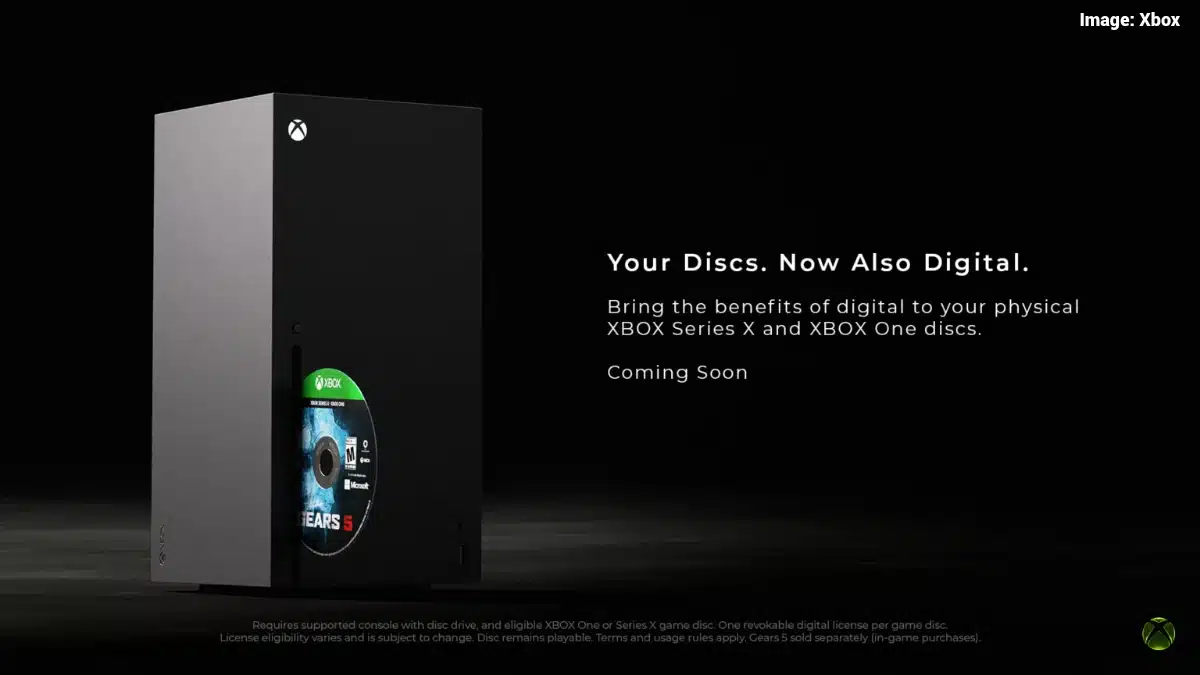
Xbox Insiders will test the feature first. Players claim an entitlement by inserting a supported disc into an Xbox One or Xbox Series X console and launching the game, after which compatible digital features become available across the wider Xbox ecosystem. Microsoft says the physical disc itself will continue functioning normally.
The distinction between a digital entitlement and an ordinary digital purchase is important.
Microsoft describes the feature as bringing “the benefits of digital” to physical games rather than replacing the disc with an unrestricted second copy. The company has confirmed Xbox Play Anywhere and Xbox Cloud Gaming support where the individual game already supports those services.
That could make some physical libraries considerably more flexible.
A supported Xbox Play Anywhere title could gain access on Windows PCs, while a cloud-enabled game could potentially be streamed to hardware that cannot read a disc at all. Current reporting also points to digital-only Xbox consoles and Windows handhelds such as the ROG Xbox Ally as intended beneficiaries of the entitlement system.
Until now, Xbox Play Anywhere has primarily treated digital ownership as the qualifying purchase. Physical copies therefore lacked one of the main advantages Microsoft has been building into its cross-device ecosystem.
Disc-to-digital closes part of that gap without requiring owners to purchase the same game again digitally.
I think that is the genuinely important part of the system: it is less about eliminating discs than allowing a physical purchase to participate in an Xbox library that increasingly extends beyond a console with an optical drive.
Microsoft says most Xbox One and Xbox Series X disc-based games will support the feature, with thousands of titles included when Insider testing begins. More games will be added over time, although not every physical release will qualify.
Older generations are a different matter.
Microsoft’s announcement specifically names Xbox One and Xbox Series X discs when explaining how entitlements are claimed. It does not announce equivalent conversion support for original Xbox or Xbox 360 discs. Those older games therefore remain outside the confirmed disc-to-digital programme for now.
This is separate from Microsoft’s existing backwards compatibility programme.
Current Xbox backwards compatibility allows compatible disc-based games to install and run on newer consoles, but the disc normally remains required in the drive as proof of ownership. Xbox Series S cannot use those physical copies because the console has no optical drive.
The new entitlement system changes that relationship for supported Xbox One and Series X software by allowing the physical purchase to gain digital functionality.
Microsoft has not publicly explained every part of the ownership mechanism in its short announcement.
Previous reporting from The Verge says the entitlement is linked to the individual physical disc rather than becoming a permanent digital copy detached from it. Under the reported system, passing the disc to another owner would also move the usable digital entitlement, preventing someone from registering a game, selling the disc and retaining permanent digital access.
That detail is particularly important for physical ownership because it would preserve lending, trading and resale rather than converting every registered disc into an account-locked product.
However, Microsoft did not explain that transfer mechanism in its August 26 Xbox Wire announcement, so the exact behaviour should remain attributed to reporting until Insider testing or official documentation confirms it publicly.
Publisher participation is another area where the official and reported states need separating.
Microsoft says thousands of games will be available and that the catalogue will expand, but does not explain why certain titles will be excluded. Earlier reporting says publishers can decide whether their games participate, meaning licensing and rights agreements may influence compatibility.
That could be especially significant for delisted games.
Xbox One titles removed from digital storefronts because of expired music, vehicle or other licences can still exist as physical copies. Disc-to-digital could potentially extend those games to disc-less hardware if their publishers authorise participation, but Microsoft has not published a complete compatibility list or rules for delisted software.
The feature also arrives shortly after Microsoft began extending Xbox backwards compatibility onto PC.
The early PC programme launched in July with original Xbox titles playable on Windows PCs and handheld devices, including ROG Xbox Ally hardware. Microsoft described that rollout as the beginning of a broader effort to move older Xbox libraries onto additional devices.
Disc-to-digital extends the same philosophy from software compatibility into ownership.
A physical library that previously depended on an Xbox with an optical drive could potentially provide access across consoles, PC, handheld hardware and cloud streaming, although the exact destinations still depend on each game’s supported features.
The timing also creates a sharp contrast with PlayStation.
Sony announced in July that it will end physical disc production for all new PlayStation games from January 2028. Games released physically before the cutoff will remain unaffected, but new releases after that point will move to digital distribution.
That decision has already triggered significant opposition from physical-game supporters.
More than 355,000 people signed a petition asking Sony to reconsider, and the dispute has since escalated into the ongoing PlayStation blackout over the 2028 disc cutoff. Participants are being encouraged to stop playing, signing in and spending money on PlayStation services until August 30.
Xbox is moving in a different direction with existing physical libraries.
The disc remains usable, while a supported game’s ownership signal can extend into digital services that were previously difficult or impossible for a physical copy to access. That gives Microsoft a potential bridge between physical ownership and its increasingly device-independent Xbox platform rather than forcing players to choose one format or the other.
The system may also become increasingly relevant as Microsoft’s hardware strategy develops.
Reports surrounding Microsoft’s next-generation Xbox plans have repeatedly suggested much closer integration between console and PC libraries, although Microsoft has not confirmed the final hardware configuration or whether future systems will include optical drives. Disc-to-digital therefore solves a genuine preservation problem without requiring assumptions about the next Xbox console itself.
Xbox Insiders can begin testing disc-to-digital on August 31.
Microsoft has not announced a public release date. Reports indicate a wider rollout is planned after the Insider phase, but the company has not yet committed publicly to a specific month or timetable.