
As a comeback mechanic, Mortal Kombat 1 gives fighters access to a powerful cinematic Fatal Blow once their health falls to 30% or lower. The selected Kameo must also be available, the attack costs no Super Meter, and a successful Fatal Blow cannot be used again for the rest of the match.
If the attack misses or is blocked, it is not permanently lost. Fatal Blow instead enters a cooldown before another attempt can be made, provided the fighter still meets its activation requirements.
Quick Links:
When Does Fatal Blow Become Available?
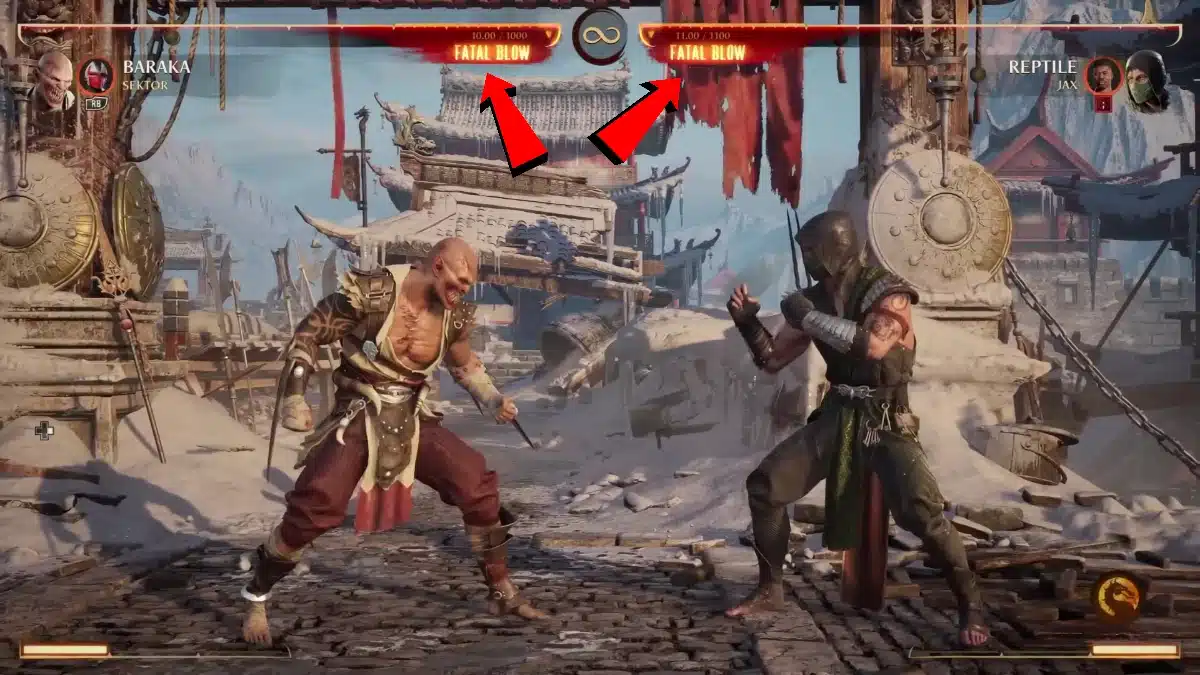
Fatal Blow becomes available when a fighter’s health reaches 30% or lower and their Kameo is available to participate.
The threshold is based on a percentage of the current team’s maximum health rather than one universal health value. This matters because different fighter and Kameo combinations can produce different total health pools.
A 30% threshold therefore does not always mean exactly 300 health.
Once the requirement is met, the Fatal Blow indicator appears beneath the health bar to show that the attack can be attempted.
Fatal Blow is designed as a comeback resource rather than something built through normal offence. Dealing damage, blocking attacks and filling the Super Meter are not what unlock it. The health threshold controls when the mechanic becomes accessible.
How Do You Activate a Fatal Blow?
A Fatal Blow is activated by pressing Flip Stance and Block together while the Fatal Blow is available.
The default controller inputs are:
| Platform | Fatal Blow Input |
|---|---|
| PlayStation 5 | L2 + R2 |
| Xbox Series X|S | LT + RT |
| Nintendo Switch | ZL + ZR |
| PC | Flip Stance + Block using the assigned key bindings |
Fatal Blow does not consume any of the three bars in the Super Meter.
Those bars remain available for other combat mechanics, including Enhanced Special Moves and Kombo Breakers. This separates MK1’s Fatal Blow from older Mortal Kombat super attacks that required players to build and spend a combat meter.
Why Does a Kameo Need to Be Available?
Mortal Kombat 1 requires the selected Kameo to be available because the Kameo forms part of the Fatal Blow attack.
Most Fatal Blows begin with either the primary fighter or Kameo connecting with the opponent before both characters participate in the cinematic sequence.

This creates an additional activation condition that did not exist in Mortal Kombat 11.
Being below 30% health is therefore not enough by itself. If the Kameo is currently performing an assist, has been temporarily knocked out or is otherwise unavailable, the Fatal Blow cannot begin until the support fighter becomes available again.
This requirement is about Kameo availability, not spending Super Meter.
It also explains one of the more confusing situations in MK1: the Fatal Blow prompt can be associated with low health, yet pressing the correct input may still fail because the Kameo is tied up in another action.
In practice, I treat the health indicator as the first requirement rather than a guarantee that the move will fire immediately. Kameo state still matters at the moment the input is made.
What Happens If Fatal Blow Misses or Is Blocked?
A missed or blocked Fatal Blow enters a cooldown and can be attempted again after the cooldown ends.
The move is only permanently spent once it successfully connects.
This produces two different outcomes:
| Fatal Blow Result | What Happens |
|---|---|
| Hits opponent | Fatal Blow is spent for the remainder of the match |
| Misses | Fatal Blow enters cooldown |
| Blocked | Fatal Blow enters cooldown |
A successful Fatal Blow is limited to once per match, not once per round.
Using it successfully during the opening round therefore removes it from the player’s options for every remaining round of that match.
Missing is less final, but it still creates a major punish opportunity. Fatal Blows generally carry enough commitment that throwing one out without a reliable opening can leave the attacker exposed.
MK1 also includes a Fatal Blow Cooldown match setting, allowing the cooldown behaviour to be controlled in custom or tournament configurations.
How Does Fatal Blow Armour Work?
Most Mortal Kombat 1 Fatal Blows use armour during their activation, allowing the attack to absorb an incoming hit without immediately being interrupted.
Armour does not make a Fatal Blow universally safe or invincible.
The opponent can still block the incoming attack, avoid its initial hit or use interactions capable of defeating the armoured startup. Individual Fatal Blows can also have different startup behaviour, hit regions and defensive properties.
MK1 exposes this behaviour through a separate Fatal Blow Delayed Armour setting.
When delayed armour is enabled, the armour does not become active immediately at the beginning of the Fatal Blow. This creates a larger opportunity to interrupt the move before its defensive protection begins.
That distinction matters when comparing Fatal Blow behaviour between normal matches, Practice Mode and tournament rulesets because the match configuration can alter how forgiving the startup is.
Can Fatal Blow Be Used in a Kombo?
Yes. Fatal Blow can be cancelled into from compatible attacks and used as part of a Kombo.
If a normal attack or string can be cancelled at the required point, the Fatal Blow input can be used to convert the existing hit into the cinematic attack.
This is considerably safer than activating Fatal Blow raw because the initial hit has already confirmed that the opponent is vulnerable.
However, Fatal Blow damage is affected by Kombo scaling.
Adding the attack to the end of a long sequence does not simply add its full standalone damage to everything that came before it. Damage already accumulated in the Kombo affects the final contribution of the Fatal Blow.
NetherRealm specifically corrected Fatal Blow interactions with reduced Kombo damage scaling during MK1’s post-launch updates, confirming that the system is tied into the game’s broader damage-scaling rules.
A Fatal Blow is therefore both a standalone comeback attack and a high-damage Kombo conversion tool, but the two uses do not necessarily produce identical damage.
Can Fatal Blow Damage Be Increased or Reduced?
Yes. Fatal Blow damage can be influenced during the cinematic when the Fatal Blow Damage Boost setting is enabled.
This is one of MK1’s least obvious combat mechanics.
During the cinematic hits, the attacking player can press basic attack buttons in time with the impacts to increase damage. The defending player can also input basic attack buttons during those impacts to reduce the damage received.
The mechanic effectively creates a second interaction after the Fatal Blow has already connected:
Attacker timing → potential damage increase
Defender timing → potential damage reduction
The first connecting portion before the full cinematic is not treated in exactly the same way as the subsequent cinematic impacts.
MK1 provides comparatively subtle feedback for these inputs, which makes the mechanic easy to miss if a player simply watches the animation after landing a Fatal Blow.
The Fatal Blow Damage Boost option can also be disabled in match settings, so the mechanic is not guaranteed to be active under every custom competitive ruleset.
Do All Fatal Blows Work the Same Way?
No. Fatal Blows share universal system rules, but individual fighters can have different startup behaviour, range, hit properties and special mechanics.
The 30% health requirement, Kameo dependency and once-per-match successful use form the basic framework, while the actual attack is character-specific.
Takeda provides one of the clearest exceptions. His Satsujin Fatal Blow allows additional basic-attack inputs to throw up to five shuriken before the cinematic portion of the attack is triggered.
Omni-Man also gained the ability to perform his Fatal Blow while airborne through an official gameplay update, demonstrating that even fundamental activation properties can differ between fighters.
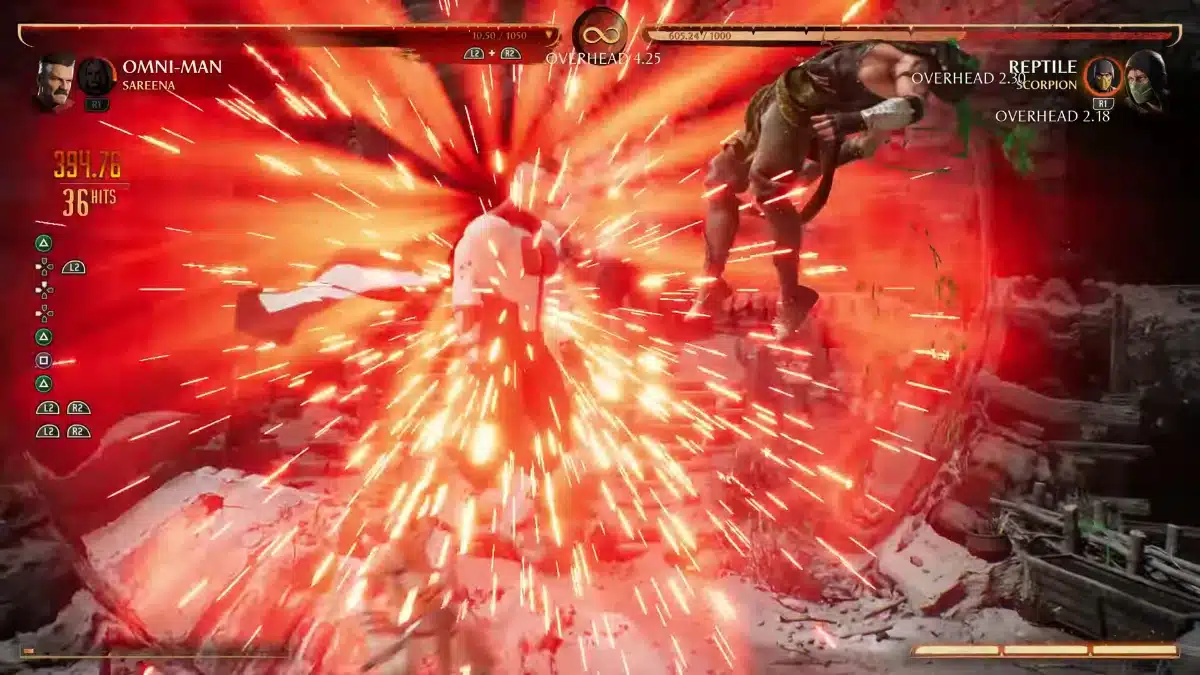
NetherRealm has adjusted Fatal Blow hit regions, armour interactions, invulnerability windows and character-specific behaviour throughout MK1’s update history.
The Fatal Blow system should therefore be understood as a universal ruleset containing individually designed attacks rather than one identical move shared across the roster.
Is a Fatal Blow the Same as a Fatality?
No. A Fatal Blow is a combat attack used during a live round, while a Fatality is a finishing move performed after the opponent has already been defeated.
Fatal Blows can damage an opponent, extend a Kombo or end a round if they remove the remaining health.
Fatalities occur after the fight has been decided during the finishing sequence and do not contribute damage to the competitive portion of the match.
Brutalities are different again. They defeat the opponent and trigger their finishing animation as part of the final attack itself, provided the required conditions are met.
Fatal Blow, Fatality and Brutality therefore belong to separate gameplay systems despite sharing Mortal Kombat’s cinematic presentation.