

Editor’s note: This review was originally published on 17 April 2013 following our experience with the PlayStation 3 version of Injustice: Gods Among Us. The article was later substantially rewritten based on our experience with Injustice: Gods Among Us Ultimate Edition on PC, which is the edition reviewed below.
When I first played Injustice: Gods Among Us on PC, I expected something close to Mortal Kombat with DC superheroes replacing NetherRealm’s usual roster. Instead, I found a fighting game with a strong identity of its own.
Injustice: Gods Among Us Ultimate Edition takes the foundations NetherRealm established with Mortal Kombat and builds its combat around the abilities of DC heroes and villains. Batman, Superman, Wonder Woman, The Flash and The Joker are not simply different character models sharing the same basic ideas. Their individual Traits, special moves and fighting styles make learning a new character genuinely meaningful.
The Ultimate Edition is also the complete version of the first Injustice. On PC, it includes the six DLC fighters Batgirl, General Zod, Lobo, Martian Manhunter, Scorpion and Zatanna, alongside additional skins and S.T.A.R. Labs missions.
Quick Links:
Combat Gives Every DC Fighter an Identity
The basic control scheme uses light, medium and heavy attacks alongside a dedicated Trait button. That fourth input is particularly important because Traits are character-specific mechanics rather than another universal attack.
Batman can summon mechanical bats that support offence and defence. Green Arrow can switch between different arrow types. Wonder Woman can change between her Lasso of Truth and sword-and-shield fighting styles.
These mechanics help make the roster feel like a collection of superheroes rather than conventional fighting-game archetypes dressed as DC characters.
There is plenty of depth beneath the accessible controls. Combos, special moves, meter management and positioning become increasingly important as you improve, while character knowledge can completely change a matchup.
Balance is less convincing.
I found projectile-heavy characters such as Deathstroke particularly frustrating when they controlled the fight from range. Closing the distance against them could become tedious, especially while still learning a character.
That never ruined the combat for me, though. Finding ways around another fighter’s strengths is part of what kept me experimenting with the roster.
Arenas Are Part of the Fight
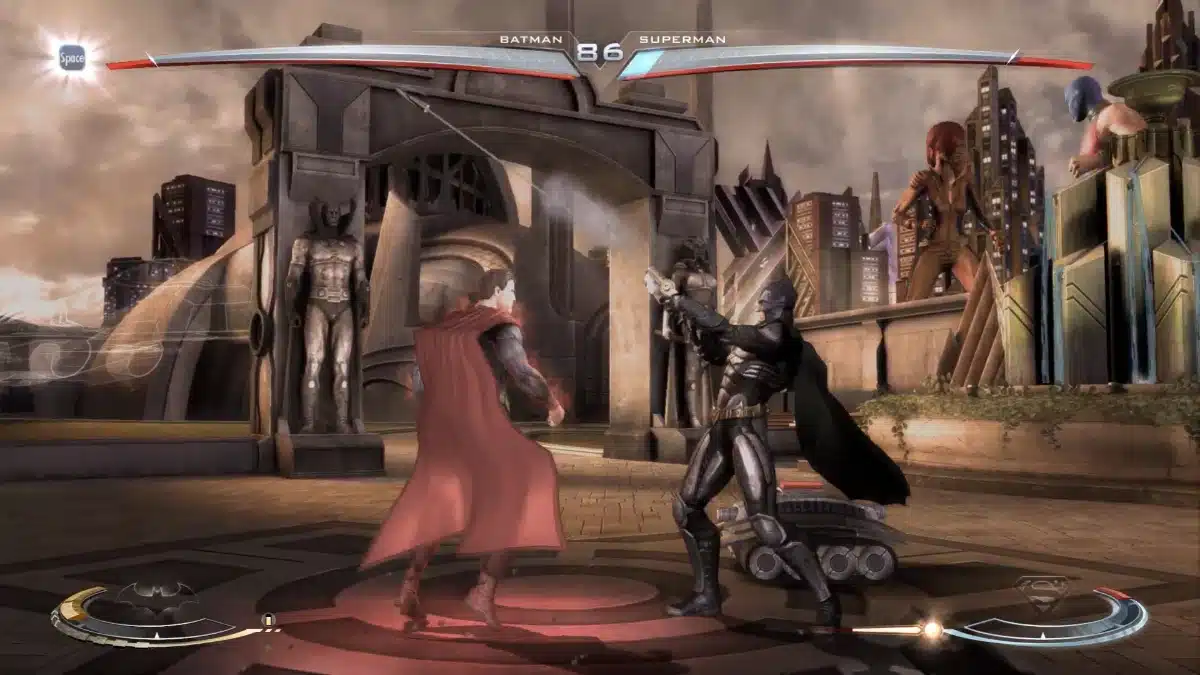
Stages are one of Injustice’s defining features because they are not simply backgrounds.
Environmental interactions allow fighters to use objects around an arena, although exactly how an object is used can depend on the character class. Stage transitions take the idea much further by launching opponents through buildings, streets and other parts of the environment before the fight continues elsewhere.
The result is deliberately excessive, but that suits DC superheroes perfectly.
Metropolis was the arena I had the most fun fighting in. Its combination of rooftops, streets, vehicles and destructible scenery made particularly good use of the environmental system, and I found that its interactive elements gave different characters useful opportunities during a fight.
It is spectacle with a gameplay purpose.
Super Moves push that spectacle even further. Building enough Super Meter lets a character unleash an elaborate signature attack, turning abilities normally associated with comics and films into huge bursts of damage.
I regularly preferred saving my meter for these attacks rather than spending it through the Clash system.
Clash Adds Strategy, but I Rarely Preferred It
Clash is a defensive mechanic that can interrupt a combo once the required conditions are met.
Both players secretly wager portions of their Super Meter. The outcome can restore health to the defender or inflict additional damage on the attacker depending on who commits more meter.
It creates an interesting decision because the same resource also powers enhanced attacks and Super Moves.
In practice, Clash never appealed to me as much as the alternatives. I usually preferred keeping my meter available for a Super Move rather than gambling it during a Clash.
That is partly personal preference, but it demonstrates one of Injustice’s better combat ideas. Meter is valuable for several reasons, so spending it always involves a trade-off.
The Story Turns Superman Into the Threat
NetherRealm gives Injustice a proper cinematic campaign rather than connecting a sequence of unrelated fights.
Its alternate DC universe is built around a Superman who becomes increasingly authoritarian following a personal tragedy. Batman leads the resistance against his regime, while heroes and villains find themselves on opposing sides of a conflict in which familiar alliances have broken down.
The campaign switches playable characters as the story progresses. That structure encourages you to experience fighters you might otherwise ignore.
I enjoyed the premise and the different perspectives, but the campaign felt too short. The story can be completed in several hours, and I wanted more time with some of its characters before control moved elsewhere.
Even so, having an actual narrative gives the fights context. NetherRealm had already demonstrated the value of a cinematic fighting-game campaign with Mortal Kombat, and Injustice shows why that approach works particularly well with comic-book characters.
S.T.A.R. Labs Offers Hundreds of Challenges
S.T.A.R. Labs provides a very different single-player experience.
Rather than following the campaign structure, its missions give characters individual scenarios and objectives. These range from conventional fights with additional conditions to unusual challenges built around a particular character or ability.
The original game contains 240 S.T.A.R. Labs missions. Ultimate Edition expands the mode with another 60 DLC missions.
Each mission contains three objectives associated with its star rating, which gives completionists considerably more to pursue than simply finishing every challenge once.
I enjoyed some of these scenarios. Others became frustrating when I tried to satisfy all three objectives.
The reward structure was the bigger disappointment for me. After putting considerable effort into completing challenges, cosmetic unlocks rarely felt substantial enough for the work involved. I would have preferred stronger progression rewards rather than having additional playable fighters distributed as DLC.
Still, S.T.A.R. Labs gives Injustice meaningful single-player content beyond its campaign and standard fights.
Multiplayer Extends the Competition

Injustice also supports local and online multiplayer, with modes including King of the Hill.
King of the Hill was particularly enjoyable because it recreates the feeling of waiting around an arcade cabinet. Players watch the current fight while waiting for an opportunity to challenge the winner.
My online matches were generally responsive, although the netcode was not flawless during the period when I played.
That observation reflects my historical experience with the game rather than a measurement of present-day network performance. Online conditions can change significantly over a game’s lifetime, particularly for a title originally released in 2013.
For competitive play, Injustice ultimately becomes much more demanding than its approachable controls initially suggest. Understanding character matchups, zoning, environmental opportunities and meter management separates casual fights from more experienced play.
Graphics and PC Performance
The PC version of Injustice: Gods Among Us Ultimate Edition offers configurable resolution and graphical settings rather than the fixed presentation of the original console releases.
Gameplay can run at up to 60fps, while pre-rendered cinematics were produced at 30fps. The game itself is capped at 60fps, so high-refresh-rate displays do not increase the maximum gameplay frame rate beyond that limit.
Anti-aliasing support includes FXAA and MSAA, with additional hardware-specific options available depending on the graphics card. Native ultrawide and multi-monitor support is limited and requires external workarounds for configurations outside the game’s standard presentation.
I am not treating these capabilities as historical GLN benchmark results. They describe the documented PC version rather than performance measurements taken during my original playthrough.
The Windows release provides more control over image quality and resolution than the original console versions, but it remains a 2013 PC port with a 60fps frame-rate cap and some limitations on modern display configurations. Its documented PC features include:
| PC Feature | Injustice: Gods Among Us Ultimate Edition |
|---|---|
| Graphics API | DirectX 10 minimum; DirectX 11 recommended |
| Resolution | Configurable |
| Gameplay frame rate | Up to 60fps |
| Frame-rate cap | 60fps |
| Pre-rendered cinematics | 30fps |
| Anti-aliasing | FXAA, MSAA and hardware-dependent additional options |
| Ultrawide | No native support; workaround required |
| Multi-monitor | No native support; workaround required |
| Controller support | Full controller support |
| Original storage requirement | 21 GB available minimum; 22 GB recommended |
Visually, the game has aged, particularly in character faces and some environmental detail, but its art direction still works because NetherRealm emphasises scale and impact.
The environments sell the fantasy better than raw graphical fidelity ever could. Buildings collapse, characters crash through scenery and Super Moves temporarily turn fights into miniature action sequences.
Ultimate Edition Is the Best Version of the Original Package
The PC release benefits significantly from being the Ultimate Edition rather than the original launch package.
Its six additional playable fighters increase the roster to 30 characters. Batgirl, General Zod, Lobo, Martian Manhunter, Scorpion and Zatanna are included rather than sold separately, alongside more than 30 additional skins and the extra S.T.A.R. Labs content.
Scorpion is an especially interesting addition because he connects Injustice directly with NetherRealm’s Mortal Kombat heritage while being redesigned to fit the DC universe.
The expanded roster also addresses one of my frustrations with the original game’s progression. I still think playable characters would have made more exciting rewards than cosmetics, but Ultimate Edition at least packages the DLC fighters with the game rather than separating them from the initial purchase.
More than a decade later, Injustice: Gods Among Us is no longer the newest take on DC fighting games. Injustice 2 expanded NetherRealm’s concept considerably, while DCKO represents a much newer approach to bringing DC characters into a fighting game.
Its environmental combat remains central to its personality. Its Traits make the roster immediately distinctive, and its campaign helped demonstrate how much effort could be put into storytelling within a fighting game.
Most importantly, I still enjoy how successfully it captures the absurd scale of superhero combat.
It has balancing frustrations, the story ends sooner than I would have liked, and S.T.A.R. Labs does not always reward the player’s time particularly well. Those weaknesses stop it from reaching the very top tier of fighting games for me.
But when Superman is sending an opponent flying through Metropolis, Batman is controlling space with mechanical bats, or two players are fighting over the last section of a health bar, Injustice understands exactly what makes its premise work.
For DC fans in particular, Injustice: Gods Among Us Ultimate Edition remains an entertaining fighter with a substantial amount of content and considerably more depth than its superhero spectacle initially suggests.
Injustice: Gods Among Us Ultimate Edition Quick Facts
Developer
NetherRealm Studios / High Voltage Software
Publisher
Warner Bros. Interactive Entertainment
Reviewed platform
Microsoft Windows (PC)
PC Release Date
12 November 2013
Genre
Fighting
Engine
Unreal Engine 3
Game Modes
Single-player, local multiplayer, online multiplayer
Playable Fighters
30 in Ultimate Edition
S.T.A.R. Labs missions
300 in Ultimate Edition
Grahics API
DirectX 10 / DirectX 11
Maximum gameplay frame rate
60fps
Original PC storage requirement
21 GB minimum / 22 GB recommended
Reviewed edition
Ultimate Edition
Injustice: Gods Among Us PC Review

Read our Injustice: Gods Among Us Ultimate Edition PC review to see how this DC brawler delivers big moments, flashy fights, and serious superhero fun.
Product Brand: Injustice: Gods Among Us
7.9
Pros
- Distinctive fighting system with unique powers for every character.
- Excellent environmental interaction and cinematic supers.
- Smooth, fast-paced combat that feels rewarding to master.
- Fun online modes with daily challenges and King of the Hill structure.
- Authentic DC atmosphere, visuals, and voice work.
Cons
- Short story mode compared to Mortal Kombat.
- Some unbalanced projectile-heavy characters.
- Star Labs challenges can become repetitive and frustrating.
- Weak rewards and paid DLC instead of earned unlocks.
- Clash system feels underwhelming in most matches.