

Key Highlights:
- China’s esports market is forecast to top 6 trillion won in 2025.
- User base reaches 495 million, with mobile titles driving most engagement.
- Shooting games dominate revenue, competition schedules, and audience interest.
China is forecasting another year of strong esports growth. According to figures shared at this year’s China E-Sports Industry Annual Conference in Beijing, the sector is set to pass 6 trillion won in revenue through 2025, marking a 6.4 percent year-on-year rise.
For context, that puts China on track to remain the most commercially successful esports market on the planet, and it aligns with the continued global shift toward live service and competitive play.
The report, presented by Tang Jiajun of the China Record and Digital Publishing Association, highlighted how lopsided the revenue landscape has become. More than 80 percent of income comes from streaming. Tournament operations and club activities make up smaller slices, which reflects how the industry has evolved into a viewer-first economy. From my perspective covering esports, this matches wider trends. Fans now consume more than they play, and broadcasters wield more influence than many organisations.

The audience figures underline that point. China’s esports user base has reached 495 million people, up slightly from last year. Mobile titles lead the market with 58.6 percent of participation, while PC games hold just over a quarter. Games that run on both mobile and PC sit in the middle ground, while browser titles barely register. Again, this mirrors my experience watching the industry shift. Developers who ignore mobile esports risk losing access to the biggest audience pool.
The genre breakdown also tells a clear story. Almost one in three esports fans engage with shooting games, which is more than double many other categories. MOBAs and sports titles split second place. Three of the ten highest-earning mobile games last year were shooters, and six of the top ten PC esports titles also fell into that bracket.
It speaks to how broad the appeal of competitive shooters has become, whether it is tactical first-person titles or the mobile battle royale scene anchored by PUBG Mobile and Honor of Kings.
Offline competition remains important too. China hosted 142 rated provincial-or-higher events last year, with more than half played entirely in physical venues. Shanghai dominates as the country’s esports hub, hosting almost one-fifth of all offline tournaments, followed by Chengdu and Chongqing. Clubs follow a similar clustering pattern. There are 165 active esports teams, and the largest concentration sits in Shanghai, Beijing, Guangzhou, and Shenzhen.
One standout example of growth is the Honor of Kings KPL finals, which filled a Beijing stadium last November with over 60,000 spectators. It set a Guinness World Record for the highest live attendance at a single esports event. In my view, that stat will become a touchstone moment because it reinforces the claim that esports can match traditional sports atmospheres in scale and energy.
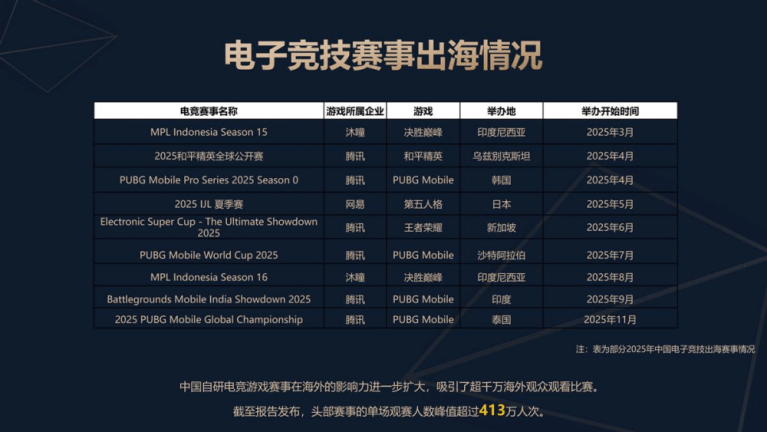
China’s position abroad has strengthened too. Homegrown titles now dominate markets in Southeast Asia, the Middle East, and Latin America. Some of these games are being written into formal sporting calendars, including the 2025 Esports World Cup and the 2026 Asian Games. International events hosted by Chinese publishers have drawn huge digital crowds, passing 10 million spectators globally.
Looking ahead, Chinese officials say their goal is ecosystem development rather than raw expansion. That means investing in better content, building global relationships, and supporting convergence between esports and other sectors. The timing is meaningful because it aligns with the close of the government’s current five-year plan and the start of a new one. It suggests policy support for esports is only going to deepen.
From an industry standpoint, China’s numbers reinforce why western developers and publishers now design with the Chinese market in mind. When half a billion people engage with competitive gaming, you do not need to be an analyst to realise how influential that audience is.
Source – Inven