
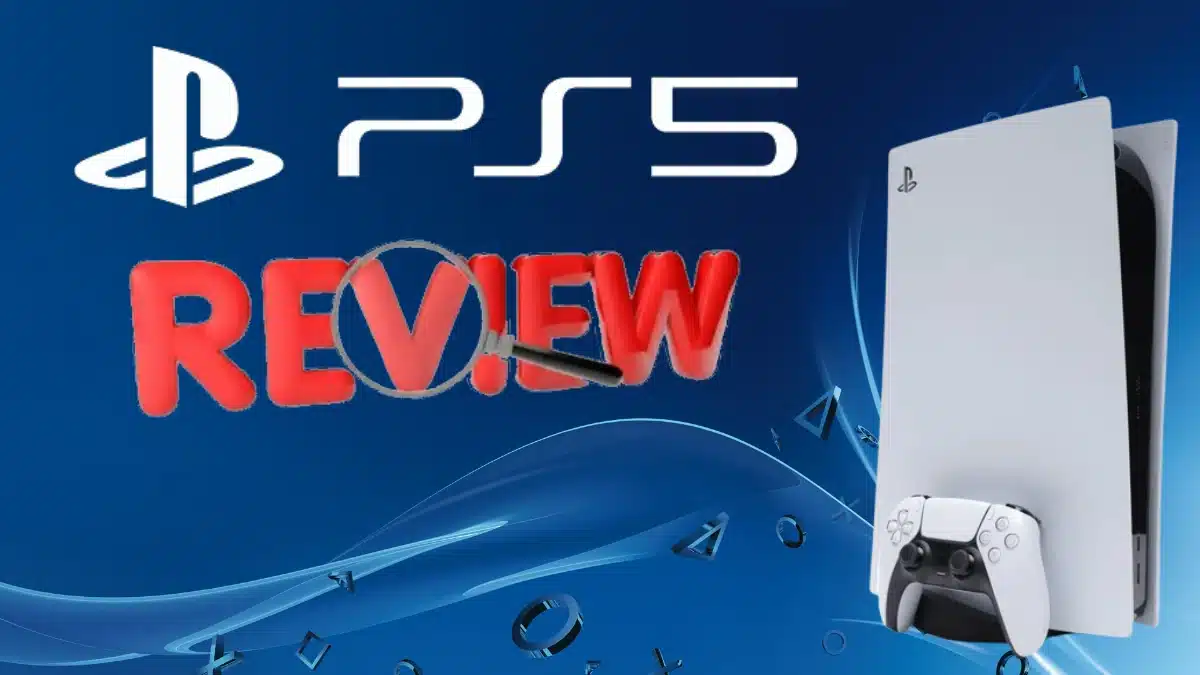
I have lived with the PlayStation 5 since the launch window, and at this point it feels less like a new gadget and more like part of the furniture. It has been five years of late nights, trophy pops, heat blasting out of the vents and a lot of genuinely brilliant games. I have tried the Slim revision and spent some time with the PS5 Pro, but this review is about the standard PS5 experience, both the original model and the Slim that replaced it, because they are functionally identical when you are actually playing games.
People keep saying the PS5 is nearing the end of its life cycle. From where I am sitting, it still feels like the centre of my gaming setup and I do not see that changing for a good few years yet.
Quick Links:
Design, Build and Everyday Use
Let us start with the obvious, the original PS5 is huge. It looks like a white spaceship with fins that crash landed behind the TV. It does not blend into a media unit in the way the PS4 ever did and it still draws comments from anyone who walks into the room. Even five years on, people tend to point at it and say something like “you have got a PS5” before they notice anything else.
The Slim revision that arrived later solves some of that. It is shorter, lighter and a bit easier to fit in a cabinet, but the basic design language is the same. If you are buying a PlayStation 5 today, you are almost certainly getting the Slim, and in day to day use it behaves exactly the same as the original. Performance in games is identical. You are not losing or gaining frame rate by going with one or the other.
Here is how the two models compare at a glance:
| Spec | Original PS5 | PS5 Slim |
|---|---|---|
| Storage | 825 GB | 1 TB |
| NVMe expansion | Internal slot (supports standard drives) | Internal slot (supports standard drives) |
| Dimensions | Large (fins, tall stand) | Shorter, lighter, fits cabinets better |
| Covers | Removable (buy separately) | Removable (buy separately) |
| Performance | Identical | Identical |
| RRP at launch | £449.99 / Digital £359.99 | £449.99 / Digital £389.99 |
The early launch units are fairly power hungry. My electricity bill definitely noticed the PS5 before I did. They also run warm. At times my launch machine has felt like a small space heater tucked under the TV. Over time the fan profile has changed slightly with updates, and I hear it ramp up more often now than I did in year one, but it has never reached the jet engine noise of a PS4 Pro on a hot day. With game audio at normal volume I rarely notice it.
What the PS5 absolutely nails is ease of use. It boots quickly, resumes titles in seconds and gets you from sofa to gameplay with very little friction. I can pick up the pad, tap the PS button and be at the dashboard almost instantly. The interface has improved a lot since launch. Trophy progress, completion percentage, friend activity and news sit neatly alongside your games. The Welcome tab that pulls together your recent titles, updates and featured content has become a really handy entry point.
Storage was one of the early disappointments. The launch unit only gave you 825 GB on the internal SSD, and once the system reserved its chunk, that filled up fast.
The Slim steps up to 1 TB by default, which is much more realistic in 2025, but the real answer is the internal expansion slot. I ended up installing an extra NVMe SSD in my original PS5 and again in the Slim, and once you do that, storage stops being something you think about.
Removable covers are a little detail that ends up feeling more important than you expect. If you hate the default white, both original and Slim models let you swap to different colours and limited designs. It is cosmetic, but it helps the console feel more like it belongs in your setup.
One of the things I appreciate about using the PS5 long-term is how many accessibility options are built straight into the system. If you head to Settings → Accessibility, you’ll find features like text size, colour correction, screen-reader support, closed captions, controller remapping, and even a zoom tool for the interface when you need it. I’ve never needed the screen-reader myself, but knowing that someone with vision or hearing sensitivities could make the PS5 usable means the console feels more welcoming and future-proof.
It’s a small detail, but for me, it underscores how the console manages to stay relevant and comfortable for a wide range of players, even years after launch.
DualSense: The Part That Still Feels Next Gen
If there is one part of the PS5 that still feels genuinely forward looking, it is the DualSense controller.
When I first picked it up it felt noticeably chunkier than the DualShock 4. Now it feels natural and I barely think about the old pad.
The haptic feedback is far beyond the usual rumble. In Gran Turismo 7 you can feel the tyres drifting across the edge of a kerb, or the slight vibration as you leave the racing line. In Spider Man you sense the thrum of webs as you swing through the city. Vibrations when an enemy is near in Silent Hill 2 Remake really enhances the experience. Astro’s Playroom goes further and turns the controller into a showcase, from crunchy snow to tiny raindrops on the shell.
The adaptive triggers change things again. Accelerating in The Crew Motorfest gives a pulse as the car shifts through gears. Heavy braking stiffens the trigger, and different weapons in shooters have distinct tension and travel. At first it is easy to write this off as a gimmick. After five years using it regularly, I genuinely miss it when I use other controllers that lack those features.
Battery life is the one real weakness of the DualSense controllers. I tend to get eight to ten hours on a charge, which is fine for a single long session but means you must remember to drop it on a charging dock afterwards or you will pay for it the next evening. A charging stand has become essential for me rather than a nice extra.
The DualSense Edge sits above it as a more specialised controller. I use it for games where rear paddles give a clear advantage, or where I want the instant trigger stops for faster inputs.
It is not something everyone needs, but it shows that the PS5 ecosystem does support higher end hardware if you want to push the console.
Games: Highs, Lows and Cross Gen Growing Pains
At the end of the day, none of the hardware matters if the games are weak. The PS5 had a slow start here. When it launched in 2020 the exclusive list was fairly thin. Demon’s Souls Remake, Spider Man Miles Morales and Astro’s Playroom carried most of the load. Miles Morales also released on PS4, which meant that for a while the generational leap did not feel quite as strong as some people expected.
The cross gen period lasted longer than I would have liked. God of War Ragnarok is a great example. It is a beautiful game on PS5 and runs well, but you can feel that it was built with PS4 hardware in mind and then scaled up. The same goes for several other big releases that straddled both platforms.
Backwards compatibility was a big win. Being able to slot in a PS4 disc and play on PS5 without extra fuss is still something I appreciate. In most cases you will see better frame rate stability and faster loading, but resolution and texture quality often remain in line with what you saw on a PS4 Pro. It is an improvement, not a transformation. Even titles like Fight Night Champion that was originally released two gens back on the PS3 is backward compatible, which I was extremely pleased about.
Once the library started to mature, the picture improved dramatically. Spider Man Remastered, Marvel’s Spider Man 2, Horizon Forbidden West, the Horizon Zero Dawn remaster, Ratchet and Clank Rift Apart, Stellar Blade, The Last of Us Part I and II on PS5, Astro Bot and God of War Ragnarok all showcase what the machine can do when developers lean into it. Astro Bot remains one of the best reasons to own a PS5, especially if you want to see what the DualSense can really do. I have sunk more than sixty hours into chasing speed run times there alone, and it even kinda won GOTY, just saying.

Gran Turismo 7 remains my favourite sim style racer on console. I have spent time with Forza on other hardware, but GT7’s driving feel, audio and visuals keep pulling me back to the PS5. Big third party titles such as Hogwarts Legacy, Elden Ring and Alan Wake 2 also look and perform very well on this console, particularly when you pick the performance options in their graphics settings.
There is a broader industry problem that the PS5 cannot escape. Too many games ship in a half finished state. We are now used to downloading a title, installing a day one patch, then waiting for several more updates before the experience feels polished. Cyberpunk’s launch proved that you can release something broken and still sell millions, and some publishers clearly took that as a template.
Upscaling technologies such as FSR and internal reconstruction are now common. When they are handled well, you get a smooth 60 frames per second experience with sharp image quality and decent lighting. When they are pushed too far, you end up with mushy or shimmering detail that looks like you are seeing the scene through a fogged window. The PlayStation 5 has the horsepower to deliver clean 4K 60 in many games, but it is not as standard as marketing slogans sometimes imply.
Remake fatigue is another trend. Some projects are justified, like rebuilding Silent Hill 2 or bringing the original The Last of Us up to modern standards. Others feel more like a loop. The Last of Us Part II and Horizon Zero Dawn both still looked excellent on PS4, yet we are already seeing new treatments. It can feel as if development effort is circling around the same safe titles instead of pushing into new ground.
PlayStation Plus, PSVR2, Trophies and Extras
PlayStation Plus is almost a given if you own a PS5 and care about multiplayer or cloud saves.
The Essential tier gives you online play, storage for your saves and a handful of monthly games. Some months are very strong, others are forgettable, but for me the cloud backup is the main reason to keep a subscription active and I treat the games as a bonus.
The Extra and Premium tiers add larger game catalogues, trials and classic titles. They can be good value if you actually plan to play through that library. If you mostly stick to a few big releases and buy what you want when you want it, then Essential will probably be enough.
PSVR2 sits on top as a more optional layer, you can absolutely own a PS5 and never touch VR. If you do invest, games like Horizon Call of the Mountain and the full VR update for Gran Turismo 7 can completely change your perception of what the console can do. It is still a niche, and you can get into VR with standalone headsets that do not require a console at all, but it is a nice option to have if you want that level of immersion and you care about trophies in VR titles.
Trophy hunting itself has become more approachable. The interface now lets you pin active trophies, see your progress clearly and track your platinum count and level. I go through phases where I chase platinums aggressively, followed by long stretches where I just finish the story and move on. The PS5 supports both approaches well, and it is satisfying to see those long term stats build up.
PlayStation Stars is a rewards programme that sits quietly in the background. You earn points for playing games and completing challenges. Those points can be redeemed for PSN credit or specific titles. Over the years I have earned enough to offset purchases I would have made anyway, which effectively feels like free money for doing what I was already doing.
Comparing PS5 to PS5 Pro
Although this review is focused on the standard PS5, it is hard not to mention the PS5 Pro because it is the obvious upgrade path on the same platform. The Pro has a significantly stronger GPU and support for Sony’s PSSR upscaling, which means Pro enhanced titles can run at higher reconstructed resolutions with more stable frame rates, especially when you want ray tracing and 120 Hz.

The important detail is that many PS5 games already look and run fantastic on the base console in performance mode. You still get 60 frames per second in a lot of titles, you still get clean visuals, and unless you are using a high end 4K 120 Hz display and have a very keen eye, the difference is not always night and day during actual play. The Pro is nice to have if you are sensitive to image quality and frame stability. It is not necessary to enjoy the PlayStation 5 library.
If you already own a standard PS5 and you are happy with how games look and run, I do not think the Pro is an essential upgrade. If you are coming in fresh with a top tier television and money to burn, it is worth a look. For everyone else, the base PS5 still holds up very well.
Long Term Reliability and Comfort
After five years, my original PS5 is still in good shape. The glossy portions have picked up a few scratches, as you would expect, but nothing has failed. The system has not suffered from crashes or serious hardware faults. The fans do spin up more often than they did in the first year, and the heat output is noticeable in a smaller room, but it has never reached the screaming levels of a PS4 that is about to take off.
In day to day use, I’ve found the PS5 to be far more power-efficient than the PS4 Pro, especially when it comes to older games and Rest Mode. When I run PS4 titles, the PS5 usually sits around the 100-watt mark, which is noticeably lower than the Pro’s typical draw of roughly 147 watts.
Rest Mode is where the difference is most dramatic. My PS5 sips about 1 watt when idle, while the PS4 Pro used closer to 5, which definitely adds up over a year. The only time the PS5 pulls more power than the Pro is during certain next-gen titles, where it can push past 200 watts and occasionally hit 220, but even then it still feels more efficient overall because it delivers higher and more consistent performance for the energy it uses. It’s one of those practical upgrades you only notice after living with both machines for a long time.
The DualSense has held up better than I expected. I have not experienced stick drift, the adaptive triggers still feel snappy, nothing rattles and all the inputs behave as they should. I am not the sort of player who throws controllers when I lose, which probably helps, but the durability has been solid so far.
In terms of comfort, the PS5 has become the machine I naturally drift back to. I have an Xbox, a Switch and a PC with a decent GPU, yet when I just want to sit on the sofa and relax with a game, I reach for the PS5 controller first. Part of that is the trophy ecosystem. Part of it is the exclusive games. Part of it is simply that the UI is clean and predictable and the machine just works when I turn it on.
Final Verdict: Is the PS5 Still Worth Buying?
If you are on the fence about buying a PS5 in 2025, I think the answer is yes. Even if a PS6 appears in the next two or three years, there is already a large library of games to catch up on and plenty more still on the way. The standard PS5 offers fast loading, a genuinely impressive controller, a strong line up of exclusives and a growing ecosystem of services and accessories.
It is not a revolutionary leap in the way the PS4 felt after the PS3. The industry around it has also developed some bad habits, from unfinished launches to endless remasters. Within that context, though, the PS5 itself is a solid, reliable console that has only become more appealing as its library and features have grown.
I do not regret buying mine for a second, and even now, five years later, it remains my main way to play games.
PlayStation 5

Is the standard PS5 still worth buying in 2025? Our 4-year review covers the DualSense's haptic feedback, game library maturity, and everyday reliability, plus how it compares to the Slim and Pro models in real-world use.
Product Brand: Sony PlayStation 5
8.7
Pros
- Strong library of first party exclusives and high quality third party support
- DualSense controller with excellent haptics and adaptive triggers
- Fast SSD and responsive UI make everyday use smooth and simple
- Backwards compatibility with PS4 titles and internal SSD expansion support
- PSVR2, PlayStation Plus and PlayStation Stars add meaningful ecosystem value
- Removable covers and wide range of controller colours for personalisation
- Solid long term reliability and stable performance
Cons
- Original model is large, power hungry and runs warm
- Battery life on the DualSense is only average and needs regular charging
- Some modern titles rely heavily on reconstruction and launch in an unfinished state
- Remake and remaster fatigue is setting in with certain franchises
- No full dynamic dashboard themes like the PS4 had
- Pro model exists, but the gap in real world experience is not huge for most players